

In a report for Czech Radio, you said: “Dad used to say that the character of Maxipes Fík was like his Lolita. On the one hand, he can’t live without her, and on the other, it’s crazy.” What relationship did you yourself have with Maxipes Fík—and how did that relationship change over time?
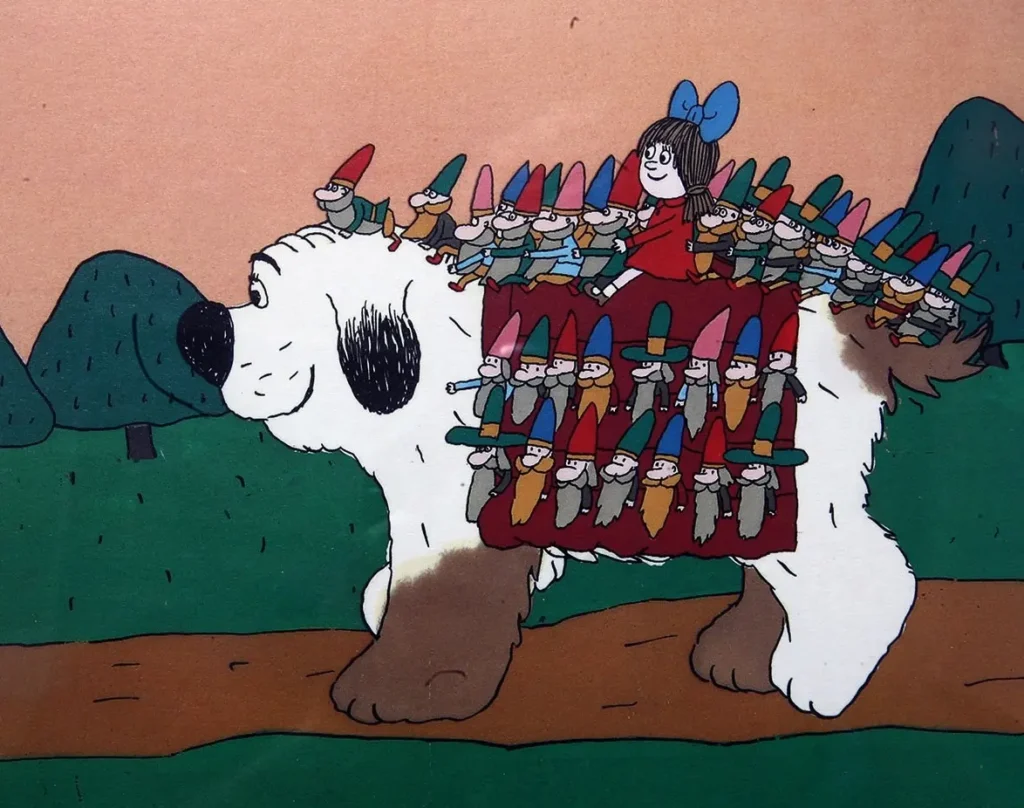
Maxipes Fík filled only a certain part of my childhood, not the one you might expect. Just before he entered the world of children in 1976, I finally got the puppy I’d so desperately wanted. In my opinion, there are no coincidences—he looked exactly like Fík. I chose him myself. And Dad probably couldn’t say no, because it was exactly the breed Fík was based on—a bobtail. Of course, ours wasn’t quite that big, but when he came home, Mom fainted. She didn’t expect a four-month-old puppy to be as big as an old money chest.
We didn’t have a TV at home, so I only saw a few episodes of “Maxipes Fík” at our neighbors’ house. It wasn’t until later that I got to know him better, and today I can say he’s a great guy alongside a sweet and good-hearted little girl. It’s one of the few children’s series where no one takes revenge on anyone or bullies anyone. And that is something I find deeply relatable and endearing.
Your father is best known to the public for his illustrations of Maxipes Fík. But his body of work is much broader; he illustrated, for example, “The Hobbit”, “Mr. Tau”, and “The Pickwick Papers”. What would you highlight from it—and is there any illustration of his that is personally closest to your heart?
My father illustrated many books, and I think they’re all wonderful. Of course, there are some that truly stand out, but the essence of his work is that he sought to grasp each one in his own way and always found new solutions. The aforementioned “The Pickwick Papers”—featuring pen-and-ink drawings with colored ink, sometimes supplemented with watercolor or tempera—and the realistic settings and characters depicted therein, simplified in a Solomonic manner, are quite different from the illustrations in “The Last of the Mohicans” (which, incidentally, was voted the second most beautiful Czech book of the 20th century last year), in which as many as four artistic approaches alternate, ranging from utterly realistic maps or descriptive details—such as a cannon or a dragoon’s uniform—to simplified, brutal ink drawings of Native Americans.
The complete opposite is the little book “Tracy’s Tiger” by William Saroyan, with its strangely contorted characters made up of various small parts—something entirely different. Only that certain roughness remains the same. A different approach every time, and yet always Šalamoun.
Your mother was also a graphic designer. What was it like growing up in such a creative environment?
Like my father, my mother created very beautiful lithographs. But she was primarily an illustrator of children’s books, both for Czech and German audiences. At the same time, for over 20 years—initially together with my dad—she was the graphic designer for the magazine “Film a doba”, whose visual style they conceived together. They included a section on animated film, to which my mom often contributed with information from various major animation festivals, such as those in Annecy or Solothurn.
When you’re a child and you’re constantly immersed in it, it doesn’t seem exceptional at all. On the contrary, sometimes you feel desperate because you’d like to do something ordinary, like what others do. But the environment itself was nice. I met a lot of interesting people who worked together and then, in their free time, came up with funny skits for their colleagues. The birthday parties at the lithography workshop on Říční Street—the oldest printer of this graphic technique in our country—were legendary. During the time I was there, it was run by two men, Tomáš Svoboda and Jiří Lípa. It was always a lively place, just like at the exhibition openings that artists would occasionally host for one another.
Of course, everything influenced me. I often drew with my dad in his studio on Pařížská Street. Sometimes he’d have me trace his drawings and watch how I handled it as a child, and I think that inspired him as well.
Was Fík inspired by your bobtail, which you insisted on getting from your parents when you were a child? To what extent did you put yourself into the character of the protagonist, Ája?
No. Fík was inspired by a bobtail that my dad once saw in England. The fact that we had him at the same time that Fík appeared in Večerníček was—and perhaps wasn’t—a coincidence. The literary model for Ája was the daughter of the author of the text, Mr. Čechura. But recently, I heard directly from my father’s own mouth in an interview—which can be found in the Czech Television archive—that Ája’s visual appearance is based on me, except for the bow. No wonder, since I was a cheerful, nice girl (laughs).
When you look at contemporary book illustration: what has caught your attention most in today’s work—and what do you think would also appeal to your father?
That’s a very difficult question. I think today’s work varies greatly in quality, because it includes people who aren’t professional artists and don’t even know how to draw. And the commercial side of things forces talented artists to draw in a way that appeals to all readers, regardless of their taste or willingness to engage with a particular artistic vision. I think this isn’t just true for us. There are also small publishers trying to forge their own paths, but even here it sometimes seems to me that these paths have been growing increasingly similar lately.
You’re following in your parents’ footsteps. Were you ever drawn to other professions or fields? And are you glad today that you ultimately stuck with the visual arts?
I had my own ideas. As a child, I was very drawn to horses; for a while, I even considered an apprenticeship program in Kladruby. Unfortunately, I never learned to ride them.
From the very beginning, and to this day, I’ve been interested in the world of detectives. I seriously considered becoming a criminal investigator. I wanted to know what drives people to take such terrible steps and commit such acts, and because I’m a socially minded person, I felt that this profession had meaning—that it would at least help victims find justice. According to my father, that wasn’t possible at the time without joining the Communist Party. I’m not so sure about that, but the opportunity is gone.
Later, during high school, I really enjoyed feature films and considered studying film production. At the same time, I’d been a fan of comic books and animated films since childhood, and I was a very frequent visitor to the cinema at the former Children’s House on Příkopy, where they ran on a loop every weekend. In the end, I did study animation, but I work across a broader spectrum of visual arts. I enjoy searching and discovering. I’m not the type of person who works in just one direction my whole life.
You also teach illustration. What do you think characterizes the upcoming generation of Czech illustrators? How are they different from before—and do we have something to look forward to?
I haven’t been teaching since 2019, so to be honest, I don’t really have a complete picture of the situation. It’s also because I’m currently immersed in sorting through my parents’ estate, which is enormous and keeps me busy 80% of the time. I try to devote the rest of my time to workshops or my own work.
But during my active teaching career, I had a number of talented students. However, as I’ve already mentioned, in today’s book market, there’s less emphasis on a distinctive personality and more on appeal. It’s quite painful for me that the appearance of a book, especially the cover, can be determined by marketing people who go by what’s “in” on the market. It’s like carrying coals to Newcastle. I still believe that the artist should guide the reader, and not the reader determine what will be drawn. Imagine telling a surgeon how to hold the scalpel and where to make the incision, just because you want it your way.
The second, in my opinion, complexity of today’s book market is that too many art schools have been established and continue to be established, and not all of them maintain a high standard. As a result, there is an oversupply of people who then struggle to make a living. We are not a large country, and that needs to be taken into account.
In an interview with Czech Radio, you also mentioned that your father drew practically all the time. How about your own creative work? Do you always carry a sketchbook and pencil with you too?
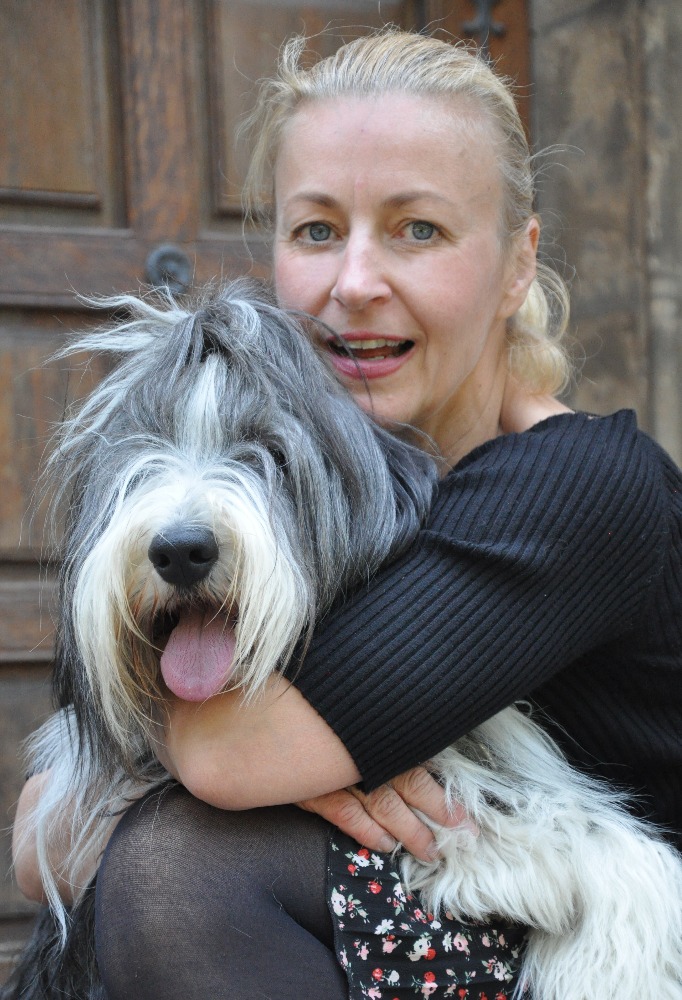
Yes, but now I mostly write down my ideas or observations. I don’t draw on the spot as much anymore, because my dog Alma runs around with me everywhere, and it’s pretty hard to do that with her.
You’ll soon be presenting your father’s work at the Leipzig Book Fair. Do you think he would have been pleased? What was it like for him to step out of his studio, where he spent most of his time alone, and go out among people to talk about his work? And how are you experiencing this event?
Definitely. He loved Leipzig very much; after all, he studied there as a “Meisterschüler” at the Hochschule für Buchgestaltung. In fact, he felt a close connection to all of Germany. He often worked there, both as an illustrator and on juries or at exhibitions. He even received the Gutenberg Prize from the city of Leipzig for his contributions to book illustration.
Unlike me, my father was able to spend hours in his studio alone with his work. That’s how I saw him as a child. Now, as I come across his various diaries, I read that he gladly traded this solitary part of his work for social life, working in a group—such as on the aforementioned Maxipes Fík or while creating his lithographs—or simply by going out to a pub with friends. He probably talked about his work among his peers, but otherwise he wasn’t the type to talk only about himself all the time. That’s what I appreciated about him. He was interested in others, in their lives and work.
Now, with age, I actually cope with solitude better, perhaps thanks to my dog. Not that I’ve stopped being sociable. I thoroughly enjoyed working with students, and I still enjoy teaching now, even though I never wanted to pursue this profession.
Photo: Barbara Šalamounová’s archive
The interview with illustrator Barbara Šalamounová was conducted by Karolína Tomečková.