

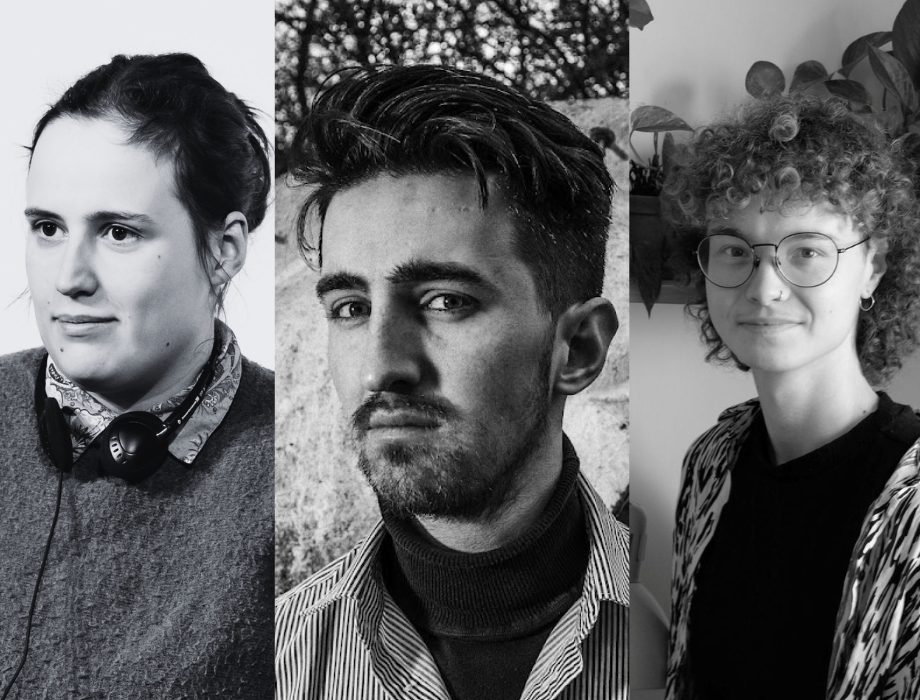
Where do you get your inspiration from?
Antonín Zhořec: Poems come to me on their own, but in order to capture and write them down, I need to be calm, uncluttered, sufficiently empty and spacious for them to settle within me. I feel that rather than inspiration, calmness or restfulness is essential for me when writing. Poems find their inspiration elsewhere; they settle within me almost fully formed. Perhaps they then grow verbally, taking on a more precise shape. Otherwise, I have the impression that they do not come directly from me, and that I do not feed them from outside (inspiration). I am merely their scribe. When a poem passes me by and I am fresh enough to notice it, I record it.
Štěpánka Borská: I find inspiration in everyday observations of everything around me, in conversations, my own emotions and those of others, in events at home and around the world, in the forest, the city, or in interesting-sounding words. I write down anything that catches my attention in notes on my phone. I used to use notebooks, but I kept forgetting to take them with me everywhere I went.
Sufian Massalema: In my writing, I often work with what could be called the “general” themes — family history, childhood, or my hometown. At the same time, I like to incorporate traditional Islamic narratives and aesthetics into my texts. In the Czech cultural context, these elements can gain new and unexpected meanings. I enjoy experimenting with what works and what does not. In my first book, a central motif was my fascination with places or things that feel niche, strange, or somehow “not quite right.” I tried to anthropomorphize them or place myself within them in order to search for my own position in the world. In my next book, I would like to revisit and further develop this idea. However, I want to shift the focus toward human traditions and the stories we tell each other — even when they are unnatural or odd — and explore how we have gradually normalized them.
What does poetry mean for you?
Antonín Zhořec: Lately, it mainly means fear that I won't be able to give it all the care I think it deserves and that I owe it. Fear makes me restless, and then I don't have enough space inside me to capture it, and I find myself going round in circles. But I believe that I will find a way out of the circle, that I will discover a secret door or kick through a hatch in its floor. Then I will be able to capture and write again. I wanted to write that I would capture poetry like a butterfly in a net—but that's not exactly how it works. Poetry needs to fly freely, and when it wants to, it will fly to me and stay long enough for me to write it down on paper.
Štěpánka Borská: The opportunity to express myself in code about things I don't know how to deal with myself. Whether it's my own feelings or the impact of world and domestic events. To a certain extent, it can be therapeutic, but it definitely has its limits. Poetry should not slip into subjectivity. I think a good text can also be recognized by the fact that readers can interpret it in different ways. At the same time, I enjoy looking for unusual word combinations. I enjoy escaping to a place where the laws of everyday life do not apply.
Sufian Massalema: That’s not an easy question. While thinking about it, I remembered a recent issue of the Czech literary magazine Tvar, which asked Czech writers the same thing. Their answers generally fell into two categories: either that it is impossible to define what poetry is or what it means, or that poetry “simply is,” often accompanied by a witty quote depending on one’s taste.
I would prefer not to fall into either of those categories. For me, poetry is a method — a tool for describing how I perceive contemporary reality and how I interpret it.
I like to imagine our world as one in which the supernatural is real, where reality is multilayered and full of mysteries that cannot be understood through reason alone. At that moment, poetry is the only way how to sufficiently talk and write about it.
Do you have a (literary) role model? What do you like to read?
Antonín Zhořec: I read texts that aren't afraid to break free from the chain, that are slightly chaotic, condensed, and spontaneous. Texts that strive to avoid mediocrity, that dig beneath the surface and subversively deal with "the world around us," whatever that may mean. I like it when writing sticks in your throat and almost suffocates you. I don't have a literary role model, but I will recommend a few books that have affected me in recent years (the ones that stuck in my throat and almost choked me—I write this with warmth and respect for them). The most recent choking experience was caused by The Suicide Museum of a Trans Girl by Hannah Baer, a cruel, transparent, pathetically and unpathetically heartbreaking read. I also gladly let myself be suffocated by The Book of Blood by Kim De l'Horizon, which angers, caresses with language, shatters the world and reassembles it, cries sincerely and deeply, breaks down values and builds new ones, but above all embraces you if you let it. It helps you find a tiny little place in a world that offers no space of its own. Then there is The Theory of the Chinese Soul by Carlos A. Aguilera, about which I don't even know what to write; the book is an opiate trip, in the best sense of the word. And from Czech literature, Ladislav Klíma's The Suffering of Prince Sternenhoch still suffocates me to this day. It is best read aloud while snuggled up with your partner in bed (that's how I read practically the whole thing), if you have a sufficiently willing and madness-loving partner. Finally, lest I forget, I am breathing in Radka Denemarková's Kobold. It's a lively read, linguistically stirring. It reads like experiencing a snake bite.
Štěpánka Borská: I closely follow debuts and enjoy reading contemporary Czech poets. Namely, and at random, Vojtěch Štěpán, Anna Řezníčková, Jakub Racek, Thea Sedmidubská, Jaromíra Zálišová, Nela Bártová, Sufian Massalema, Tim Postovit, Zofia Bałdyga, and authors who have published their books in the poetry edition of the Odeon publishing house. I also went through a phase of fascination with established authors, such as Ivan Wernisch. I combine poetry with prose and I really enjoy literary reportage, especially those published by the Slovak publishing house Absynt.
Sufian Massalema: In fiction, I would name Orhan Pamuk as a major influence. I aspire to write about ordinary things and human stories with the same depth and sensitivity that he does. In poetry, I am inspired by Islamic Sufi poetry and by poetry from the Mughal era in India. I also deeply admire the work of František Halas and Vladimír Holan. Many of my friends from the literary world are also my role models. In each of them, I see qualities that I feel I lack, and I am constantly trying to grow and improve so that I can reach their level.
You are all living in Prague: What is your favorite spot there?
Antonín Zhořec: My favorite place in Prague is a willow tree that grows near where I live. I call it my willow tree, but of course it isn't mine, I don't own it. It is my willow tree in the same way that I am (or could be) its person. I often go to visit it and watch how people have combed its hair. It grows above the sidewalk, so every time it gets in the way of people walking comfortably, they cut it back. I admire its hairstyles. I reach out to touch it, and when it's freshly cut, I have to jump up to reach it. If you want to see it too, you can find it here. Please be gentle with it. Of the places you can enter, my favorite is Safe Space, a proudly feminist establishment that will be closing at the end of this year and would certainly welcome a little love from the people who come there. They have great vegan food, and you can also fill up on books there.
Štěpánka Borská: In Prague, I like the Žižkov district, which has its own unique character. The numerous pubs contribute to this. I also like the more unexplored parts of the city. For example, the Slatiny shantytown, where Jonáš Zbořil set his novel Flora.
Sufian Massalema: Although I’m not a hardcore train enthusiast, my favorite place in Prague is a spot above a railway tunnel between the Vinohrady and Nusle districts in the city center. In the evenings, I like to watch the night trains pass by and wonder where their passengers are coming from and where they are headed.
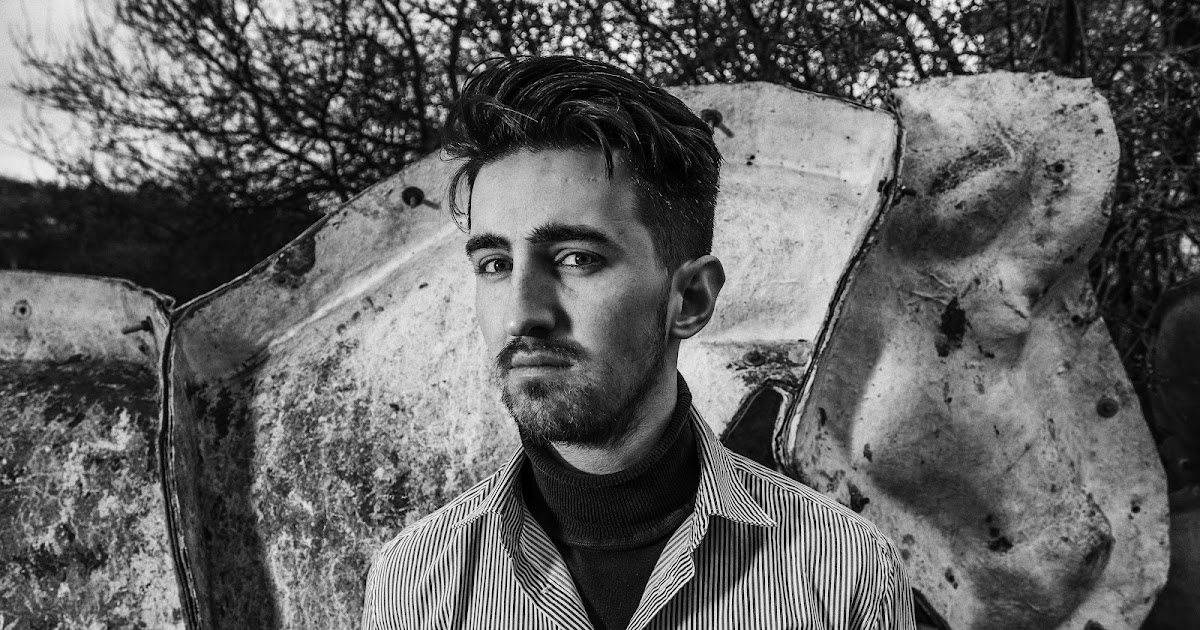
Antonín Zhořec (*2000) is a community coordinator at Amnesty International and a queer activist. He studied Hispanic studies at Charles University and is currently studying gender studies at Charles University's Faculty of Humanities. He writes reviews for Revue Prostor and participates in author readings on a semi-regular basis. He has published poems in Psí víno, the cultural biweekly A2, the weekly Tvar, and the anthology Toto je môj coming out (Adolescent, 2022). In 2023, he was awarded second place in the Vladimír Vokolek Literary Prize and received an honorable mention in the Jiří Červenka Literary Competition. In the spring of 2024, his debut poetry collection Rejpnu si do solární bouře (I'll Dig Into the Solar Storm) was published by Adolescent.
Poem: I remove orange seeds from a burning pig
simple manual work suitable for heavy metal machinists
a whining head beats a drill covered in orange juice
protective equipment includes foot gloves with a back flap
orange trees with orange leaves grow nearby
signs warn against frequent changes in body position in the machine
the burning pig climbs on your hands
workers wearing helmets are at risk of being polished by pigs with heavy metals
you insert the little finger of your left foot into the drilled hole in the orange
orange trees increase the birth rate of burning pigs
orange leaves maintain room temperature
supervision is provided by burnt tufts of grass near the damp little finger
the burning pig stood up
we always place the broken drill under the hands of the orange trees
heavy metal machinists eat orange seeds
we drill through the little fingers of orange trees at room temperature
pigs with orange leaves grow nearby
Štěpánka Borská (1997, Brno) has published in Tvar, Hostinec, Weles, and Psí víno magazines. She has successfully participated in the Vladimír Vokolek Prize, the Ortenova Kutná Hora festival, and twice in the František Halas Literary Competition. She studied Czech language and literature and journalism in Prague. She works in the media. She co-organizes regular author readings called Poezie & piano (Poetry & Piano) and runs a poetry profile on Instagram called poetickýmezichlebník (poetic breadbasket).
Poem:
I limit communication with my family to press releases
abandoned factory halls press down on old concrete
the air is stifling in the deciduous forest
understanding evaporates quickly
how much violence can we endure
before the edges bend
international law recoils
like an oversalted tree
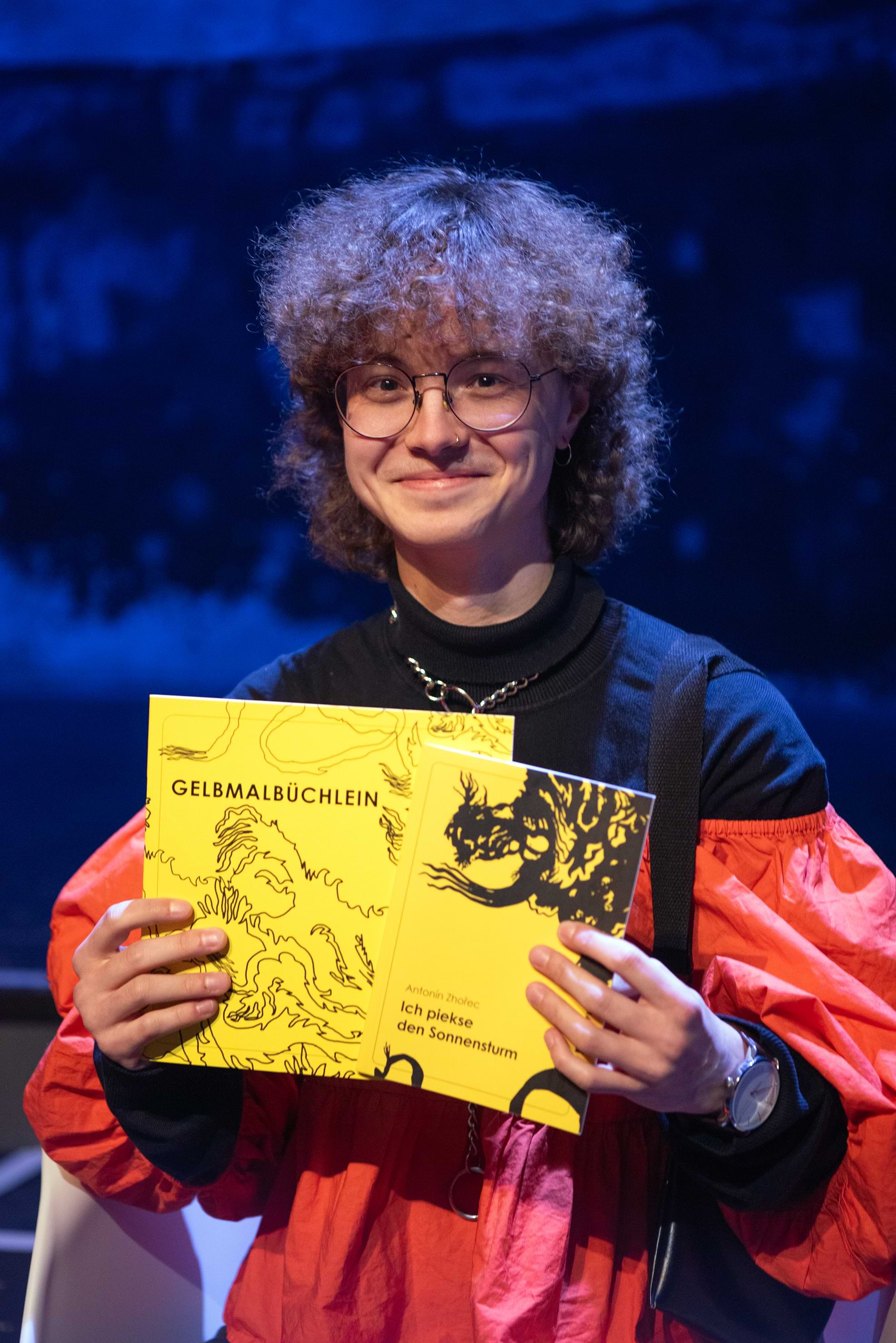
Sufian Massalema (*1999) was born in Jablonec nad Nisou. Alongside his studies, he focuses on slam poetry and writing poems. His texts have been awarded in the Vladimír Vokolek Literary Prize and the Václav Hrabě Literary Competition in Hořovice. His debut poetry collection Možnosti přehlíženého (Possibilities of the Overlooked) was nominated for the Jiří Orten Prize. On the one hand, his work depicts the inhospitable Sudeten landscape and his own sense of not belonging there; on the other, it presents images from a journey to the land of his ancestors. The language of his poems combines standard Czech with elements of colloquial speech and Arabic, expanding the semantic space of the text. He moves freely between epochs, geographies, and cultural traditions without giving in to romanticization.
Poem: Basra
a helicopter over Basra
like a ceiling fan
the rotor frequency
counts down the time until the start
of the afternoon news
we have contests to see
how many comics we can stuff
into one banana box
fishermen floating into the harbor
debate over wrecks of tankers
words leave room for interpretation
the trunk of the family Volvo has never been smaller
The interview was conducted by Annika Grützner.