

What kinds of things can be expressed in Czech that are difficult or impossible to express in German?
As a linguist, I naturally say: In principle, I can express anything I want to in any language. It’s just that the means of expression differ from one language to another. Expressions that seem to have the same meaning actually have slightly different nuances. Or, for something I can express with a single word in one language, I might have to resort to a rather long-winded phrase in the other.
Does a character’s personality change when you translate them from Czech into German?
No. And if it does happen, then I’ve probably done something wrong. Or—which is no less bad—misunderstood something.
When you translate, do you tend to think in images, in meaning, or in words?
I translate texts. At first glance, they consist of “words,” but that focuses only on the surface. Words have—or acquire—meanings, and of course, the audience’s interpretation of the text also conjures up images. Ideally, I manage to convey all the nuances of meaning into the target language, but generally my goal is for the reader of the German text to form the same or at least very similar images, so that similar feelings are evoked. In short: I cannot translate one of these three aspects without the others.
What makes Czech humor particularly difficult to translate into German? Which Czech jokes don’t work at all in German?
Humor is generally difficult to translate. That’s because it often relies on allusions and misunderstandings. The reference point is frequently a regionally specific phenomenon—such as well-known figures from the past and present, historical events, pop culture, or everyday life—that is completely unknown in the context of the target language. This strips the joke of its foundation—and leaves me with a tough nut to crack.
Or the whole thing is based on a linguistic slip-up, which is then highly problematic. Because if I introduce a slip-up borrowed from the German language into a text set in a Czech context, it creates an imbalance. (I can’t rule out, however, that I’ve done it before.)
I don’t want to discuss content-related and/or stylistic aspects here, because that would immediately lead me into cliché-ridden territory. Clichés—especially those that the cultures of the source and target languages use about each other—are not irrelevant in translation (quite the contrary, one should be aware of them), but they are not suitable as categories.
What do you love about Czech that you miss in German?
The conciseness. A text translated from Czech (or Slovak) into German can be 25 to 30 percent longer. Slavic languages basically function like Latin—relationships between sentence components are made clear through endings. This also allows for much greater freedom in word order in Czech.
I also miss the ability in German to clearly indicate the correct pronunciation of a word.
How has translating changed your own German?
The German language is my tool. So I have to make sure to keep it well-maintained and ready for use. In other words: Aside from Czech and Slovak books, I read mainly literature written in German. But it’s just as important to read works translated into German. Both writers and translators are, after all, the authors of their German-language texts and thus an important source of inspiration for me.
What are your favorite words in German and Czech?
I have a soft spot for expressive terms. In German, I’m a big fan of the Saxon multifunctional groan “Ooohr näääj!”, which expresses a very high degree of disapproval. Unfortunately, you can’t fully capture its acoustic qualities on paper. (See also my comment on this above.) And of course, this exclamation is also accompanied by a corresponding pout.
In Czech, there are many terms with German roots that also tend to have an expressive quality. My favorite is “rambajs,” the term for deafening noise in the presence of people behaving chaotically (often in large groups). I picture a typical scene from Alemannic Carnival: discordantly played (brass) wind instruments plus percussion, combined with bizarre costumes and loud shouting.
What are you currently working on, and what will your next project be?
I’m currently editing Marek Toman’s novel České sklo, which will soon be published by Drava as Bohemian Glass.
At the same time, I’m working on the MYKO project, a kind of graphic novel that will be published by the Hamburg-based publisher Ankerwechsel. The premise is: “Mushrooms reporting for mushrooms about mushrooms,” in the form of the magazine MYKO, with one volume—ten brightly colored issues (illustrations by Daniela Olejníková), including two double issues—compiled into a single anthology. It features interesting facts about the world of mushrooms, historical and mycomythological content, as well as poems (the texts are by Jiří Dvořák). It’s a lot of fun, but also a dense collection of puzzles I have to solve.
And then I’ll also be getting involved in a Slovak project again: In his novel Sviňa (Sow), Arpád Soltész has taken up the case of the murder of investigative journalist Ján Kuciak and his partner Martina Kušnírová in February 2018, along with the political turmoil and mafia-like corruption in Slovakia (under the Robert Fico government), and turned the whole thing into a gritty, hard-boiled, hardcore text. The Berlin-based publisher Voland & Quist is releasing the book to shine a spotlight on these issues, which are unfortunately still relevant today.
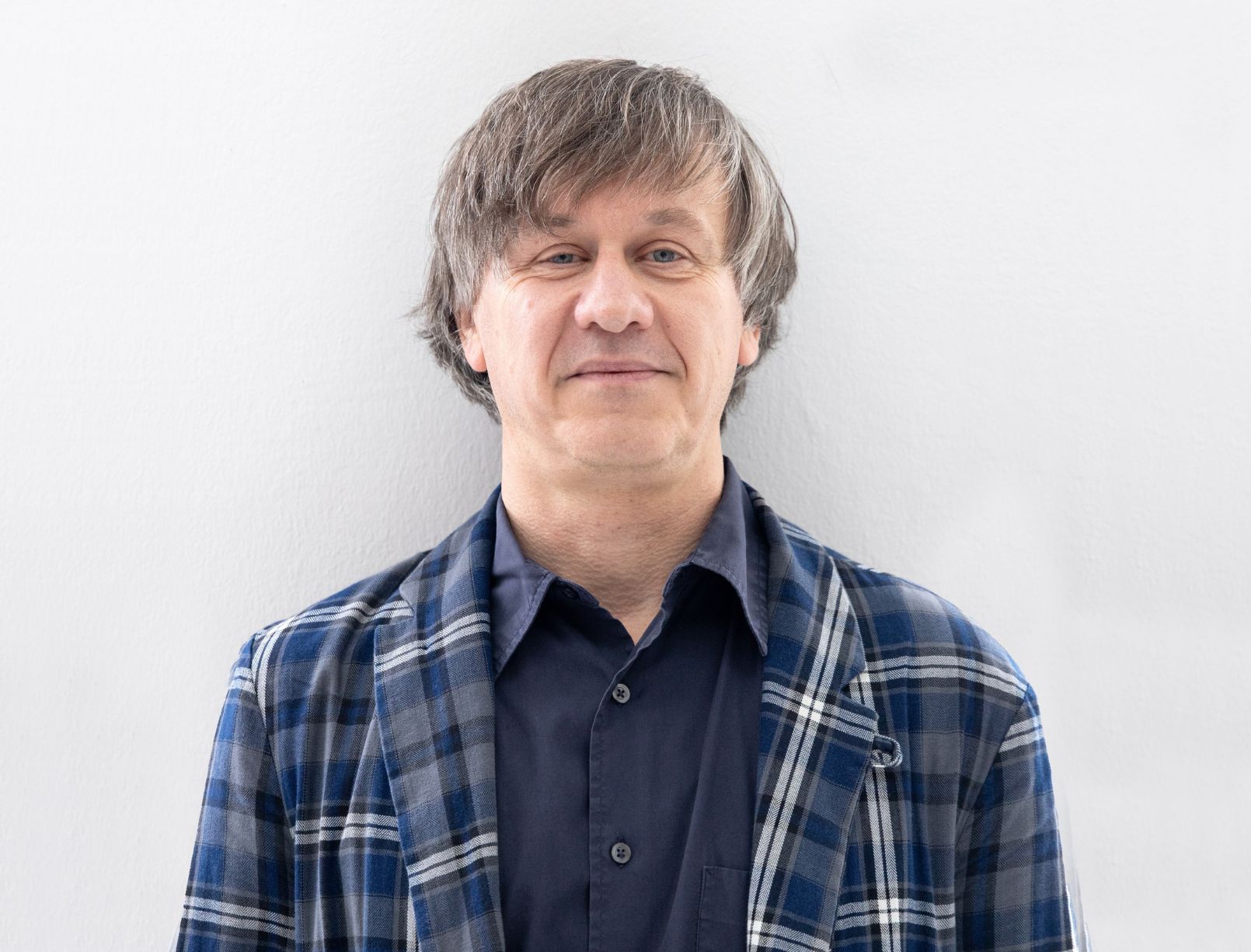
Photo: Pavel Němec
The interview was conducted by Annika Grützner.