

Vratislav, the title of your new book is quite bold. Did you know right away what it would be? How did it come about? Were there other options discussed?
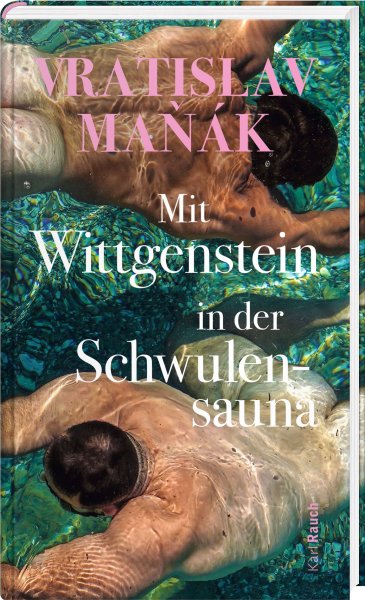
The combination of Wittgenstein and gay saunas is obviously contrasting, but I didn't intend it as a provocation for its own sake. It is primarily meant to capture the tension that the book conveys: the tension between language and the body, between what we usually articulate and what happens without words. And because in all the texts I examine male homosexuality in Central Europe, the title also functions as an economical shorthand. The sauna refers to gay culture and its sexual dimension, while Wittgenstein also serves as a substitute symbol for the region under examination and the author's chosen approach.
Why Wittgenstein in particular? What attracted you to him in particular among all the philosophers?
I wouldn't overestimate his importance in the book; he is just one of a number of thinkers who accompanied me while I was writing—others included Eva Illouz, Byung-Chul Han, and Jacques Lacan. Together, they helped me answer the questions I was asking myself.
Which ones were they?
What is the appeal of Berlin clubs? And under what circumstances do we allow ourselves to be pathetic? And although Central European gay culture led me to these questions, their significance is no longer unique to homosexual men—and the philosophical and sociological arsenal helped me to understand what the book wants to convey to readers. In Wittgenstein's case, it is specifically about thinking about how we experience our own physicality.
Wittgenstein says that what cannot be spoken about must be passed over in silence. When we apply this to the environment of a gay sauna: what is actually talked about there? Is it a space where we can finally be ourselves, or is it a place where even our thoughts remain hidden under a towel?
To be honest, there isn't much talking in a gay sauna. It mainly offers a non-verbal experience, because it focuses a person on experiencing their body, or rather on experiencing their body reaching pleasure. And as for those thoughts… rather than under a towel, they are stored in lockers at the entrance, and even the towel itself is often a nuisance here.
It seems that this is your first book that deals more extensively with the topics of sexual and gender identity. Why did you decide to tackle them now?
It was more about the author's evolution than a revolution, because I already worked with gay themes in the novella O Žitovi (About Žita) in the short story collection Smrt staré Maši (The Death of Old Maša) and I also addressed them in my essayistic prose Goethe v Mariánských Lázních (Goethe in Mariánské Lázně). The change seems significant mainly because with the new book I am moving to non-fiction, and moreover without historical background – and because this type of writing requires a stronger personal experience than classical prose, I could only embark on it when certain experiences became articulable. However, I would not like these words to give the impression that the book is a personal confession. I don't need to confess anything, it's just that this time I'm not building the text around a story, but around an idea.
You will be discussing the book at the Leipzig Book Fair. How do you feel about talking about these topics publicly in front of an unfamiliar audience?
Intimacy in literature is not the same as intimacy in life. When I try to name a certain phenomenon or experience, I give it shape and structure, and I use the written word to create distance. The public debate is then no longer a confession, but a reflection on the text. Nevertheless, I understand what you are asking. Of course, talking about intimacy can be sensitive, especially when it comes to minority intimacy. At the same time, however, it is quite liberating—when the word homosexuality is used so often in the public sphere, it is appropriate to look at what the word actually means. And if we talk about it in a civilized manner, it is a relevant part of public discussion.
In the book, you combine personal testimony with reportage and, at times, philosophical reflections. This may make it a more demanding read—who is the book intended for? Who might it appeal to?
With Wittgenstein in a Gay Sauna combines reportage, essay, and personal reflection, which can indeed make it more demanding – but at the same time, it fits the theme. Sexuality, language, and identity are neither simple nor one-dimensional. I think it will appeal to those who like to seek out literature as a space for thought, and not just for exciting stories.
You have also previously published collections of short stories, Smrt staré Maši (The Death of Old Maša) and Šaty z igelitu (Plastic Dress), for which you won the Jiří Orten Award. Are these shorter formats – whether short stories or reportage – something that is close to you literarily?
Short stories, reportage, and essays have something in common: concentration. They don't offer much room for verbosity, because every sentence has to convey a precise meaning, and this style of writing suits me at the moment. What's more, the spectrum of short genres is very diverse, which makes it possible to seek out new combinations, stylistic fusions or, in other words, new forms of storytelling.
This isn't the first time you've appeared before a German audience. Do you feel a little bit at home there now?
I am a Czech author, I write in Czech and I think in Czech, so home is too strong a word. But it is certainly true that I feel more confident in German-speaking countries every year – thanks in large part to the translator Lena Dorn and the trust of my German publisher Karl Rauch Verlag. German is also a natural medium of learning for me, and I much prefer to read fiction and non-fiction texts that have not been translated into Czech in German rather than English – and this does not only apply to titles that were originally written in German. Translations here have undergone a selection process that can be trusted because the local perspective is culturally close to ours. And on top of all that, there is Germany itself. You see... any Czech who likes to look at the world from a broader, let's say historical perspective, cannot ignore Germany. Its regional reach is enormous, its culture has been extremely influential for hundreds of years, and our connection due to geographical proximity is unbreakable. That's why I like to visit Germany and Austria—every trip is an opportunity for me to understand the local identity and, thus, the region in which I live.
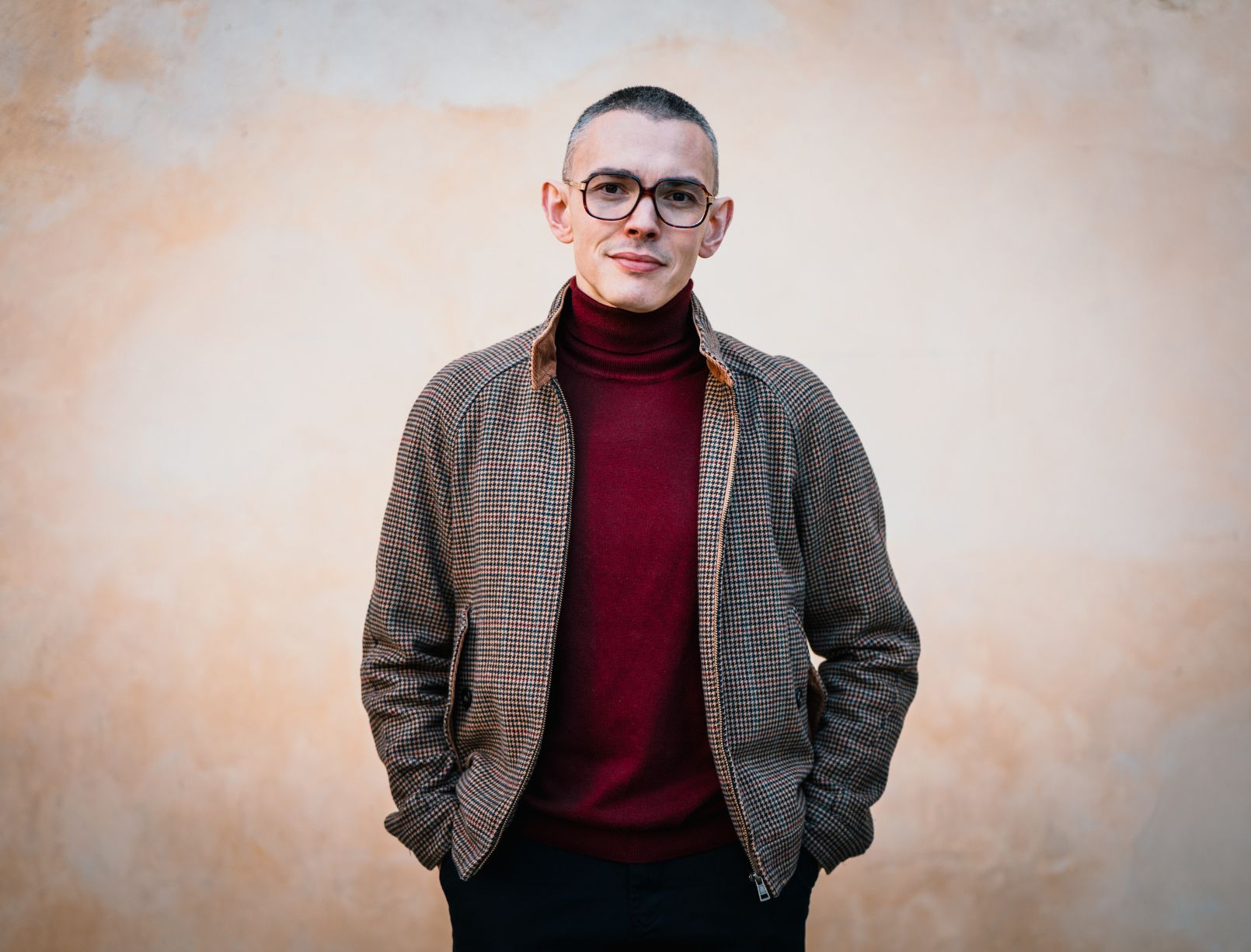
Photo: Věra Marčíková
The interview was conducted by Karolína Tomečková.