

Marie, among the animals (or plants) that appear in the collection, do you have a personal favorite?
Among the plants, I feel closest to the Xanadu philodendron, which is plagued by a housing crisis and its own sensitivity to the cold. But there’s nothing it can do about that, because it’s a tropical plant. It’s one of the few poems where I allowed myself to project my own feelings and worries onto someone else. I’m talking about the plant and, at the same time, about myself. Or to put it another way: the philodendron in the poem is me, and I am the philodendron. Among the animals, my favorites are my cat Luna and my tomcat Ferenc. With them, too, I allowed myself to be very personal. After all, I wrote a book of poetry, not an ornithological guide or atlas.
Do you remember the initial impulse for the collection? Was it a specific image or situation, or rather a long-term observation of the city?
It was an encounter with a pheasant at a construction site in Bubny. But it was preceded by other encounters, some dating back to my childhood. And also a certain awareness that our perception of nature as something opposed to the city stems from ingrained habits and perhaps even a kind of blindness.
When you let animals and plants “speak,” how do you find that fine line so their voices don’t come across as too humanized or too didactic, yet still feel authentic?
Letting animals and plants “speak” is always problematic. There’s a danger of excessive anthropomorphism—that is, projecting human traits or experiences onto them. Nevertheless, I decided to write some poems from the animals’ perspective. These include texts where rats or peacocks speak about their coexistence with humans. Or a text where a bat has a nightmare about becoming human. I seriously considered including a note somewhere describing how perfect a bat’s organism is—how its metabolism burns away all the diseases that develop in us humans, and how, relative to its size, it lives an extraordinarily long time. That’s why the idea of becoming human terrifies it. But in the end, I had to give that up so as not to be too didactic… In similar poems, I’ve always relied on scientific facts and worked with them. When I write that rats “squeak with laughter,” it’s not a poetic metaphor or my own invention.
It’s also important to note here that animals are capable of things we previously considered exclusively human. We know they can play, mourn, or care for older members of the pack or flock. So what is still anthropomorphism, and what is the attribution of traits we previously reserved only for ourselves?
I tried to balance the poems written from the perspective of animals or birds with texts offering a different perspective, where the speaker and observer is a human. In those, I often ask questions rather than answer them. Or I question the language we use to talk about animals. It’s similar with didacticism; I know that in some places I pushed the boundaries. I was aware of all these risks, and I also knew that they couldn’t be completely avoided.
Urban habitats such as streams, rubble piles, street canyons, or green corridors appear in the poems. Is there a place that you are drawn to the most, somewhere you like to return to?
I like these hidden corners of the city. When I lived in Libeň, I really loved the spots by the river where a new neighborhood has since sprung up. In Žižkov, I loved the meadows and thickets that stretch along the train tracks beyond the Žižkov Tunnel. In the book, it’s more of a sum of all these places, a sort of essence of them. The poem about the rubble is written with Kyiv in mind, where there are many modernist brick buildings falling into disrepair, and every brick bears a specific mark that tells its story. I also really love urban streams—overlooked, often dirty, channeled underground, and only occasionally surfacing. People from Prague will surely think of the Botič or the Rokytka, but I’ve read that there are more than a hundred of them in Prague.
The collection also works with the motif of traps (glass, light, bars…). Was it important for you to show that life in the city isn’t just idyllic?
Yes, that was one of my motivations, and it’s one of the book’s central themes. From the perspective of birds and animals, the city is full of traps. People are only gradually becoming aware of this, but they are becoming aware of it nonetheless. And things are starting to change a little.
While reading, I was reminded of Gary Snyder more than once; he, too, focuses heavily on animal themes, and you quote him in the introduction. Was he an inspiration to you? Who else influenced you while writing?
Gary Snyder is one of the most important authors for me. My text about pheasants that hunt people is a direct paraphrase of one of his poems. I shifted it a bit, but the meaning remained the same: the hunter and the hunted have swapped roles. The works of Louise Glück and the Polish poet and naturalist Urszula Zajączkowska were also important to me; both have poems about plants. At the end of the book is a complete list of the scholarly and popular science literature I drew upon. I knew critics would hold that against me, and that’s exactly what happened. But that was my intention and my method: I based my poems on facts and real stories.
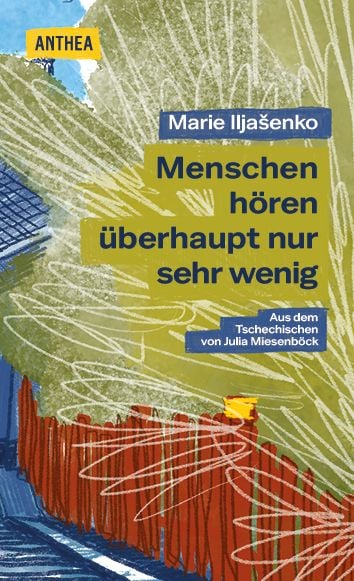
The collection is now being published in German translation. This is your first German translation, isn’t it? How do you feel about that? To what extent were you involved in the translation process?
I’m very happy about the publication. I was quite closely involved in the collaboration, though of course only to the extent possible without knowledge of the target language. The translator, Julia Miesenböck, and I discussed how to handle certain passages. At the same time, I let her do what she thought was best, because I know her and trust her.
What was it like working with Mariko Gelman? What do you think the illustrations bring to the collection, and how do they influence the way we read it? What drew you to her work in particular?
From the moment I saw her sketches of cities, I knew I’d like to work with her. I think illustrations generally add another dimension to a book, and when done well, they elevate the book to an aesthetic artifact.
The theme of travel often runs through your work. Where do you feel most at home right now? And which recent trip abroad inspired you the most?
My home is in Prague. But I perceive the concept of home more broadly. Rather than a single point, it’s more like concentric circles. Thanks to my roots and the fact that I love to travel, I feel at home throughout Central Europe. And traveling around Europe often reinforces this sense of an expanded home. My stays in Barcelona and Berlin were a great inspiration for me, as were all my trips to Kyiv, where I return regularly. I consider Kyiv my second home, and I have another one in the Broumov region.
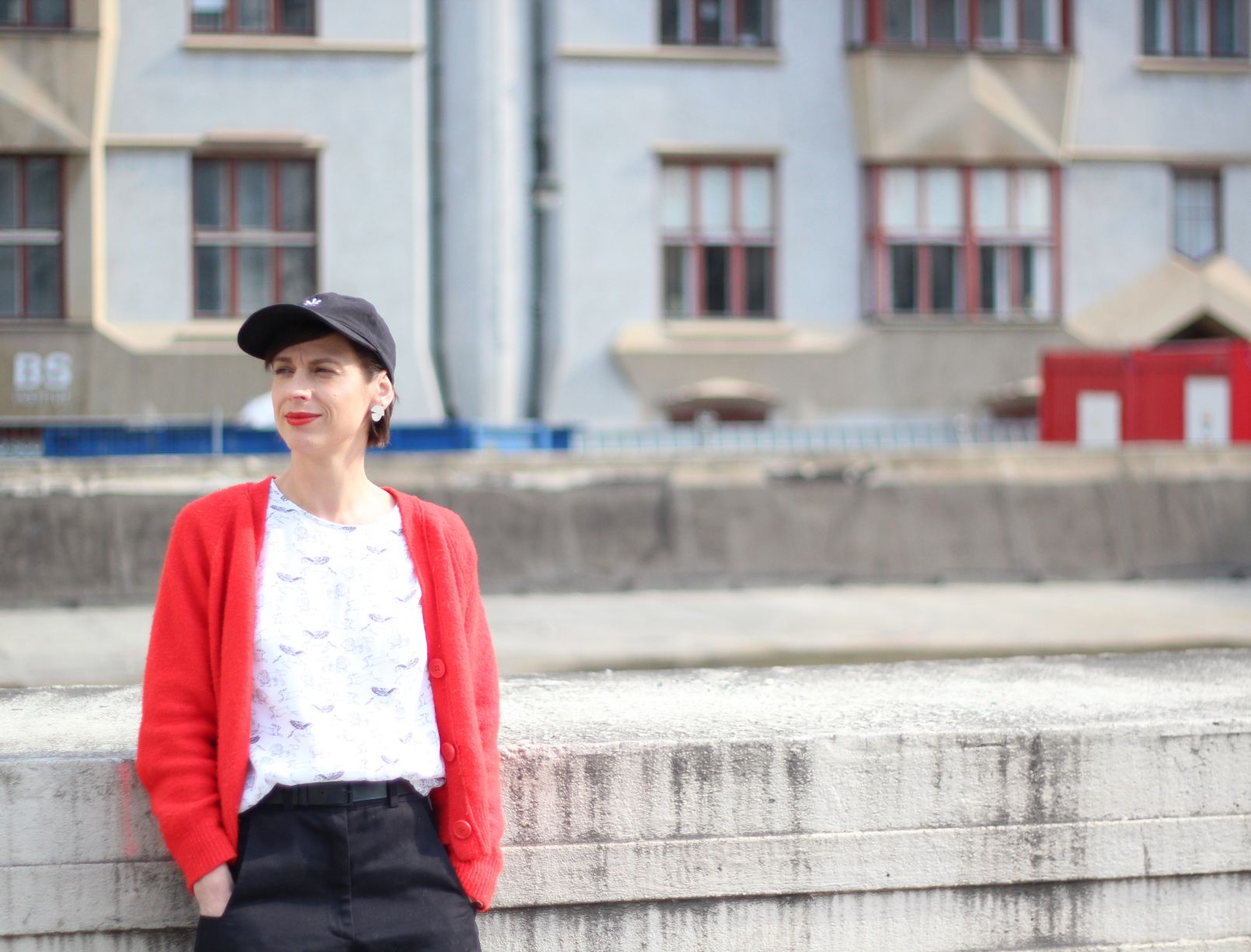
Photo: Petr Gojda
The interview with author Marie Iljašenko was conducted by Karolína Tomečková.