

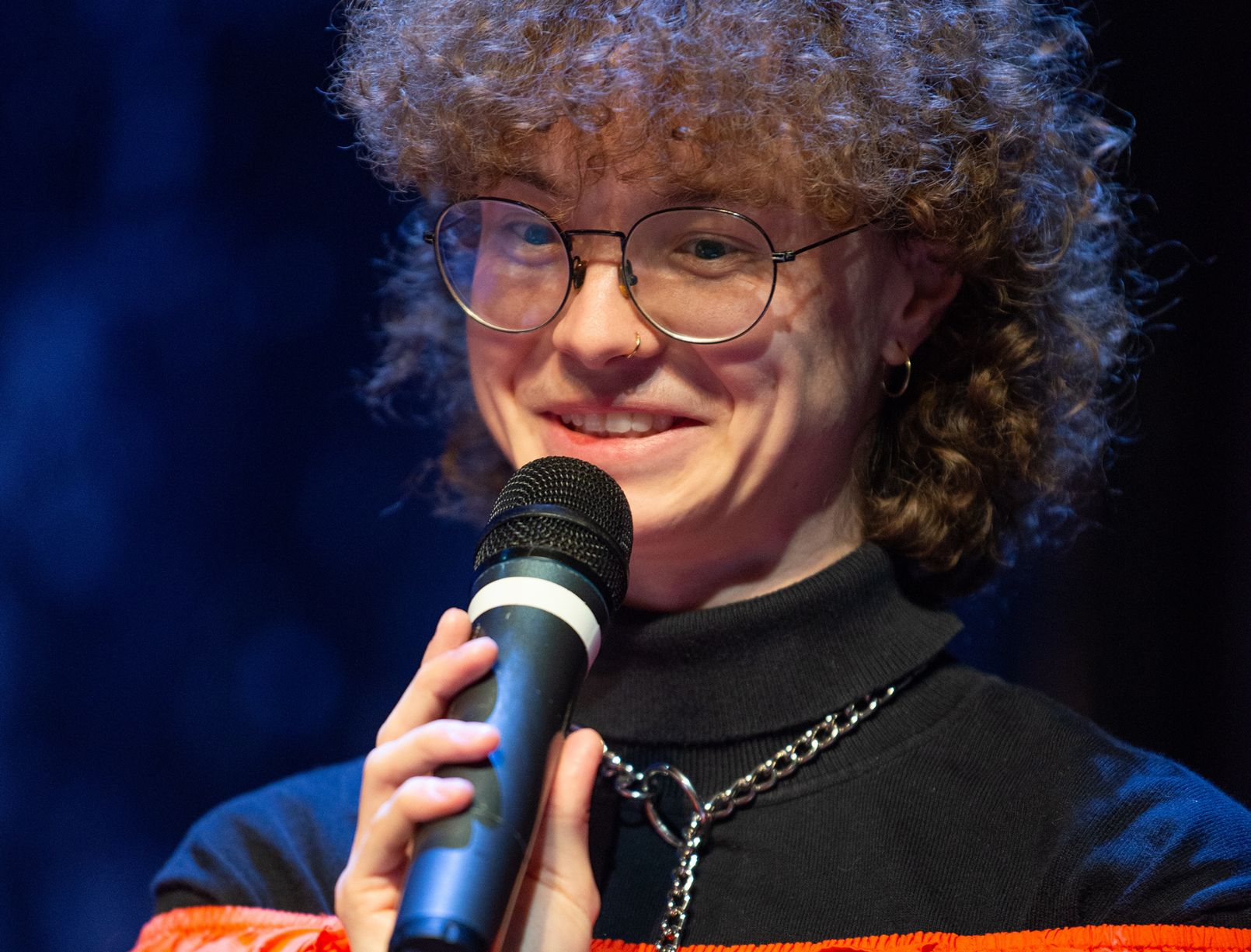
Antonín, what happens when you poke at a solar storm?
The sun will wane, and people will feel sunburns beneath their skin and embers beneath their feet. A blind man will cry out: “soleil, soleil.” The mangy sunbeams fall to the ground. That, I think, is how the poem in which the collection’s title verse appears would answer. A solar storm is a wild revelry, and nothing can be said with certainty; on every page of the collection, the revelry unfolds differently and not always pleasantly.
What does poetry mean to you?
Lately, for me, it mainly means the fear that I won’t be able to give it all the care I think it deserves and that I owe it. Fear stirs restlessness within me, and then I no longer have enough space inside myself to capture it; I’m caught in a vicious circle. But I believe I’ll find a way out of the circle, that I’ll discover a secret door or kick through a hatch in its floor. Then I’ll be able to capture and write it down anew. I wanted to write that I would catch poetry like a butterfly in a net—but it doesn’t work exactly like that; poetry needs to flutter freely, and when it wants to, it will fly to me and stay long enough for me to write it down on paper.
I think “surrealism” is an apt description of your poems. Is this a style you’ve found yourself in? Where do you draw your inspiration from?
The poems come to me on their own, so perhaps a more fitting question is what prompts them to come and why it’s precisely these poems that come. I often write down the most essential verses just before falling asleep or just before waking up; in that sense, the writing process is undoubtedly close to surrealism. The most crucial parts come from the fringes of dreams. If I were to stick to the idea of inspiration, my main inspiration is distancing myself from the waking state.
I feel that rather than inspiration, what is essential for me when writing is calm or restfulness. The poems draw their inspiration elsewhere; they settle within me almost fully formed. Perhaps they then grow further in their wording, taking on a more precise shape. Otherwise, however, I have the impression that they do not come directly from me and that I do not provide them with nourishment from the outside (inspiration). I am merely their scribe. When a poem passes by me and I am alert enough to notice it, I record it.
Do you have any literary role models? What do you like to read?
I read texts that aren’t afraid to break free, that are slightly chaotic, dense, and spontaneous. Texts that strive to avoid the mundane, dig beneath the surface, and take a subversive approach to “the world around us”—whatever that may mean. I like it when writing gets stuck in your throat and almost chokes you.
I don’t have a literary role model, but I’ll recommend a few books that have moved me in recent years (the ones that stuck in my throat and nearly choked me—I write this with warmth and respect for them). My most recent choking sensation was caused by The Suicide Museum of a Trans Girl by Hannah Baer, a cruel, crystalline, and both pathetically and unpathetically heart-wrenching read. I also gladly let myself be choked by The Book of Blood by Kim De l’Horizon, a work that provokes, caresses with language, shatters the world and reassembles it, wails honestly and deeply, breaks down values and builds new ones, but above all embraces you if you let it. It helps you find a tiny little spot in a world that offers no space of its own. Then there’s Carlos A. Aguilera’s Theory of the Chinese Soul, about which I don’t even know what to write—that book is an opium-induced trip, in the best sense of the word. And from Czech literature, Ladislav Klíma’s The Suffering of Prince Sternenhoch still haunts me to this day; it’s best read aloud while snuggled up with a partner in bed (that’s practically how I read the whole thing), provided you have a sufficiently willing and madness-loving partner. Finally, lest I forget, I’m savoring Radka Denemarková’s Kobold. A spirited read, linguistically exhilarating. It reads like experiencing a snake bite.
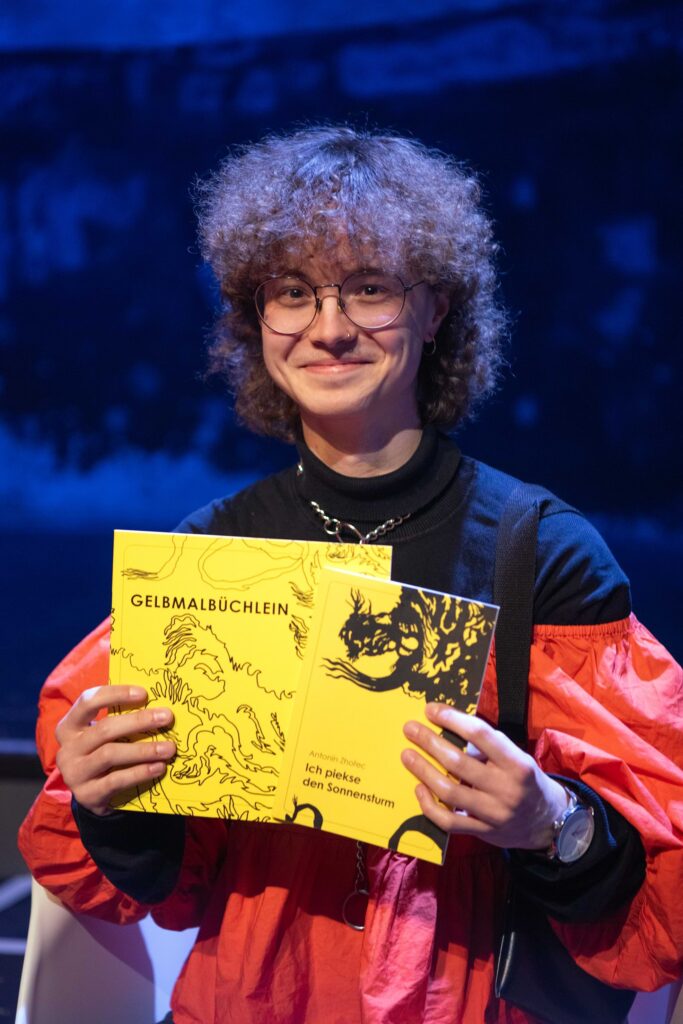
The theme of physicality appears in the collection. Is physicality an important aspect of the collection for you, or is it just one theme among many? And when you write about the body and physical experience, is there something liberating about it for you?
Physicality! That is absolutely essential to me in the collection, at least in hindsight. When I was writing it, I didn’t think about it, but if I were to imagine the same collection now, with physicality (and all its forms) removed, it seems to me that what would remain would be a short, terse leaflet with a few tiger hairs stuck to it.
Rather than liberating, I’d say it’s inevitable when it comes to writing about physicality. Or through physicality. Or because of physicality. Mainly, I suppose, through physicality—I experience writing very physically; I often feel it settle into my body; it happens that I can’t fall asleep because I feel a poem inside me. I have no choice; in such moments I must write and bring the text to a reasonably finished form so that it, now more on paper than in my body, allows me to rest. All my poems come from the outside and through the body onto the paper, so the body takes root in them (just as poems take root in the body). It finds its way into some more, into others less, but I think that in the end, it’s in every poem.
As I was browsing through your collection, I was struck by how often the tiger motif appears in it. I immediately thought of Tracy’s Tiger (by William Saroyan), in which the tiger serves more as a symbolic companion to the main character. What is your tiger like? What does it represent in your collection?
The tiger is a massive, teeming, multi-toed, long-clawed nightmare (but not only that!). The tiger represents a profound experience of various kinds. I can only say this with significant hindsight since writing the collection; for a long time, I was unable to answer questions about the tiger, even though they’re the first to come up when people ask me about the collection. For a while, I even asked interviewers not to ask me about the symbolism or meaning of the tiger, because I would likely cause an awkward silence or come up with a terse answer that doesn’t begin to capture everything the tiger represents. Now I can simply sum it up as a profound experience. The essence of the tiger is also the reason why it is so elusive and changeable; a profound experience is fleeting and multifaceted.
In your collection, you work with languages other than Czech; you studied Spanish at Charles University. Do you also write in other languages?
I don’t write exclusively in other languages; I feel most at home in my native tongue. In other languages, I trust translation more than my own ability. However, there are certain phrases, terms, or nuances that Czech cannot capture quite as well at first glance, or whose sound is insufficient for what I’m trying to name, and another language offers a smoother solution; in such cases, I don’t shy away from using a foreign word if it fits into the poem. But it must not have a comprehensive Czech equivalent. If it does (and I notice it), I prefer to use that one. In my first collection, I was open to all linguistic elements that could find their way into my writing; in the upcoming second collection, I have deliberately limited myself to basic Czech and supplementary Spanish. The poems in the second collection are, in a way, more tightly knit and therefore require a more tightly knit linguistic approach.
You are active in the LGBTQIA+ community. How does this experience influence your work? Can it serve as a tool in the search for your own identity?
I don’t feel a clear-cut identity within myself; I label my different aspects using identity categories only when it’s necessary for interpersonal understanding—that is, outside of myself. I don’t feel any distinct identities or identity-based experiences within myself; I often even label my different aspects however suits me at the moment, when I’m among people who can laugh it off and understand me. But I certainly write just as queerly as I am queer myself, in a non-identity-based sense. For example, I perceive the decay of bodies, the intertwining of bodies, and the transformation of bodies as a fluid element, just as I perceive the grasping of emotions through animality.
So when it comes to the search for my identity, writing is not that tool for me. As for other people, I can’t say, but I would wish that, if my poetry were to be such a tool at all, it would be more of a tool for the joyful experience of one’s own existence in its most subversive, most elemental forms.
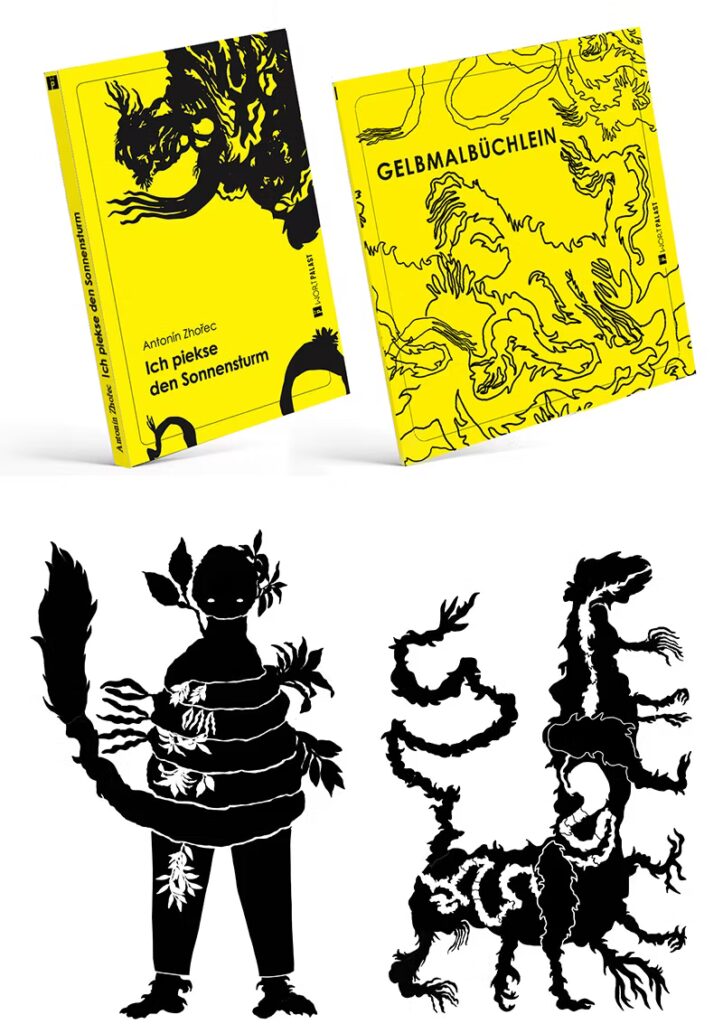
You also contributed to the visual design of the collection. Which came first—the poems or the visuals? Or was it the other way around? Or did both develop simultaneously? What set the direction?
The poems came first, and they all already had their final, edited wording when I started working on the illustrations. I wanted the illustrations not just to accompany the collection, but rather to expand it, to give the tiger new forms and dimensions. I think I succeeded in doing that only when I created the coloring pages
The coloring book is included in the collection. Is this a way to make it more interactive? To break through the passivity of the readership? Or is the reason something entirely different?
I think the collection would be incomplete without the coloring book; the coloring book is part of it, just as the collection is part of the coloring book. I don’t see either part as an accessory to the other. The collection might hold its own without the coloring book, but it wouldn’t be complete. I can’t be the only one poking fun at the solar storm if the teasing is to serve any purpose.
You recently appeared at a literary event in Berlin. What was it like? What was the audience’s reaction, and what impressions did you take away? Was this your first literary event abroad?
The reading in Berlin was enjoyable! I read alongside three young poets I know, so we had a great time together not only on stage but also off it. I appreciate the audience’s feedback; it was thoroughly kind. I remember that the audience appreciated the word “otherworldly,” which I used to describe my poems. I needed to say something specific and couldn’t find a suitable expression in my everyday vocabulary; this word was my last resort to avoid filler sounds. Actually, I usually do that—I make up words. At first, I was embarrassed when I couldn’t (and this happens to me often) name things using appropriate existing words, especially from a poet’s perspective. But now I don’t hold back when a word I’ve made up wants to come out of me. I don’t always realize in time that it’s made up, so there’s no way to hold it back. That’s my strongest experience from Berlin: the feedback that people don’t mind this makeshift naming, that they can even appreciate it. I do this kind of linguistic quirkiness in my poems as well, so I apply that feedback to them too, even though it probably wasn’t intended to go that far. And yes, the Berlin reading was my first literary event abroad; I’m truly grateful for the opportunity.
Last week you spoke at a literary event that was part of the Czech Republic’s participation in the Leipzig Book Fair—that’s a big deal. What do you think made your text stand out?
I’d guess it might have caught people’s attention because of its unruliness. It spreads out in all directions and doesn’t stray from any of the paths it sets out on, even if that path leads, for example, to a vivid image of disgust, pathos, a hard-to-grasp jumble of half-formed words, or feverish passion. At the same time, it manages to hold itself together in its disorder, because it is firmly gripped in the clutches of a tiger, fire, and the color yellow.
Photo: Sabine Felber, Literaturtest
The interview with author Antonín Zhořec was conducted by Karolína Tomečková and Annika Grützner.