

Lucie Lomová, illustrator
I’m so glad I was able to attend the Frankfurt Book Fair as one of dozens of authors on the Czech team. I was there for four days, from Thursday to Sunday, with a packed schedule and interesting experiences right up to the very last moment. When the fair ended, it seemed to me that I hadn’t managed to do nearly everything I’d wanted to.
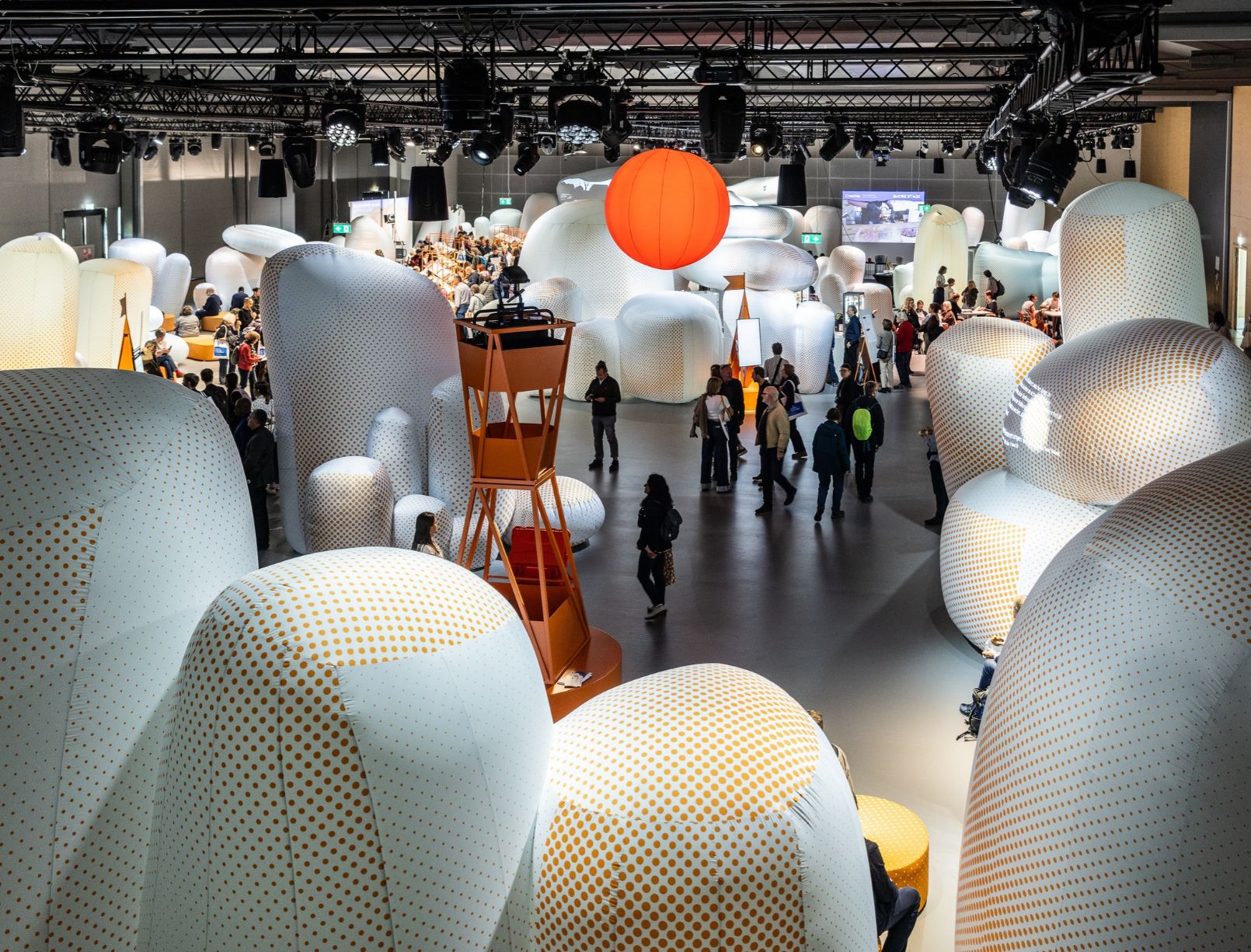
I was surprised by the size of the Czech pavilion; it looked smaller in the renderings. At first, I didn’t like the idea of a “coastal” theme, but I have to admit that it worked quite well and was quite poetic. I think the idea of inflatable boulders (they earned various nicknames from different participants!) was excellent—definitely memorable and striking. In that huge space, they managed to create a more intimate refuge and a sheltered spot; they came across as friendly and playful.
I really like the large drawing wall and the overall concept of those fleeting, temporary images, and for me personally, this live drawing session—in great collaboration with Drawci—was one of the most enjoyable experiences.
The Czech national stand was pleasantly functional and tasteful, but I didn’t spend too much time there, nor did I give it much thought. Perhaps there wasn’t enough space for the audience during the readings, but I understand that space was generally limited, given all the functions the stand had to fulfill. I liked the simple tables and chairs made of boards held together with straps.
I really enjoyed those four days; I met many people I already knew, as well as new ones I got to know thanks to Frankfurt.
Thanks to the partnership with Polle magazine, I was able to publish a comic story there alongside other Czech female authors and get to know them. I’ll always have fond memories of the evening at Romanfabrik, where Czech and German comic artists sat down at the same table to improvise together.
Both of my panel discussions—one with Štěpánka Jislová and the other with Jaromír Švejdík—were moderated by the excellent Kateřina Čopjaková, so they were carefully and well prepared, as they always are with her.
I really appreciate the professional approach, the friendly and businesslike manner, and the perfect organization of the Czech team—I didn’t encounter a single problem. A big thank you and my admiration to everyone who spent so much time preparing the Czech delegation’s visit to Frankfurt; it was wonderful.

Martin Vopěnka, writer and chairman of the Union of Czech Booksellers and Publishers
I think the Czech design of the pavilion did a great job of shielding the space from the chaos of the fair, so people felt comfortable there. This contributed to the unprecedented turnout for the Czech program. The interest exceeded even my wildest expectations. On the other hand, I wasn’t pleased with the politicization of the opening ceremony—I think a celebration of literature deserves a deeper speech, one that delves into the inner self, rather than a fiery yet ultimately empty one. And my personal feeling: As always in Frankfurt—somewhere between euphoria and the words of the Old Testament Preacher: “Vanity, all is vanity…”
Nikola Richter, mikrotext Publishing House
Everything was in motion: in the playful pavilion—where you couldn’t tell if you were in a children’s bouncy castle or a surreal mushroom forest—a shark-shaped balloon floated above the visitors’ heads and the books. And all around, the Czech language rang out, the poetic secret language of this book fair.
Unfortunately, I arrived late to the opening because of the booth setup, but I caught Radka Denemarková’s timeless remark: “Ministers of Culture come and go, but literature remains.” And I also heard thunderous applause. Then the melodic humming, murmuring, and incantations of singer and violinist Iva Bittová filled the air, striking straight to the heart.
I was running after Czech author Dora Kaprálová, this year’s winner of the European Prize for Literature, who had so many meetings, readings, and interviews that I needed a constant line of communication with her via WhatsApp: “Do we still have enough books on the Czech book table? Where are you? Good morning! I have a gift for you here: shimmery eyeshadow. And now I also have an English excerpt from your book, published by Větrné mlýny, at the booth.”
In the spirit of the finest magical tradition, during Dora Kaprálová’s reading from her award-winning novel “Die Mariborhypnose” (our fair bestseller!), we—under her guidance and together with the audience—hummed a tribute song to Anne Carson for a full minute.
And now we’re off again, perhaps to Mikulov. We heard at the fair that it’s supposedly very beautiful there.
Czechia, thank you for having us! The connection endures. We’ll keep traveling, reading, and humming.

Kateřina Tučková, author
Attending the Frankfurt Book Fair was a unique opportunity for me to meet an international audience as well as a number of colleagues—both writers and representatives of foreign publishing houses. I was particularly delighted by the presentation of the film adaptation of my book “Gerta Schnirch” (published in German by KLAK Verlag under the title “Gerta. Das deutsche Mädchen”), which premiered in Frankfurt even before its broadcast on the ARTE television channel.
The German audience may have noticed the controversy that accompanied the opening of the fair, during which members of the Czech delegation confronted the Czech Minister of Culture. We reacted spontaneously to the situation our country currently finds itself in—namely, a situation in which the Czech cultural community is being deliberately harassed by the government’s authoritarian measures. What was important, of course, was that this took place on the international platform of the Frankfurt Book Fair, because it was there that we were able to share our concerns about the future direction of the Czech Republic with colleagues from other countries facing similar problems. Now we can better support one another and work toward common solutions.
Michaela Dermauw, Host Publishing House
Until recently, I could only dream of participating in the Frankfurt Book Fair from my position. I organize events with our authors in the Czech Republic, not abroad; I neither buy nor sell rights, so what would I be doing there? However, thanks to the Czech delegation’s presence and the fact that a significant portion of the Czech delegation consisted of our own authors, Host took the plunge and set up its own booth. And since I’m a German studies graduate who welcomes any chance to speak German, one thing led to another, and before I knew it, I was in Frankfurt.
What was it like? Spectacular and beyond expectations! Full of inspiring encounters with people in the field. Everyone was there! Networking at our booth and beyond was in full swing, and the Czech national stand across from us naturally played right into our hands—visitors happily flowed back and forth between our neighbors and us. Would we like to go back? Absolutely! But it will never be the same again.
And the Czech pavilion? Well, that was a true haven. You just wanted to lie down on one of the stones (or hide behind it) and open a book, or just listen to the sound of the waves, watch passersby, read the poems imprinted on the surrounding boulders, watch illustrators at work… I have fond memories of the pavilion, its atmosphere, and the numerous events that took place there.
From my perspective, the Czech participation was an incredible success. I realize that the overall result must have required a lot of painstaking work and stress, the effects of which are likely still being felt. That’s why I have great respect for the organizers and want to thank them. Thank you for letting us be a part of it.

Vratislav Maňák, author
One expects that extraordinary moments will also look extraordinary and unique—and that one will immediately recognize when one finds oneself in the midst of something that won’t happen again anytime soon. Perhaps right at the moment when the Czech Republic suddenly transforms into a coastal country.
The Frankfurt Book Fair, however, consists primarily of meetings and rushing from one to the next, of conversations that sometimes resemble speed dating, of crowds of people, and of tens of thousands of titles vying for attention.
The Czech Republic has earned that attention this year, and I hope we can all continue to benefit from it for several more years. After all, the Frankfurt Book Fair is first and foremost a place of business—and the public’s attention is an exceptionally valuable commodity these days.
For me personally, however, this participation held value in another way as well. It truly was a rare moment when so many authors gathered in one place at the same time with a common goal—to represent Czech culture. And it is a great honor for me to have been a part of it.
Veronika Chaloupková, Foreign Rights Manager and Literary Agent at Argo Publishing
On behalf of Argo Publishing, I would like to thank the Moravian Library for its excellent organization of the Czech participation at the Frankfurt Book Fair. I was very satisfied with both the organization and the overall presentation. It was clear how much work and care had gone into the preparations, and the result was a professional and representative presentation of Czech literature.
I was also very impressed by the fresh concept of the Czech pavilion, which presented the Czech Republic as a coastal country. Its striking, imaginative design gave the Czech participation a distinctive and easily recognizable identity. The pavilion had a contemporary and confident feel and effectively captured Czech literature as a vibrant and diverse part of culture. I appreciate the courage to come up with an original concept that managed to captivate and spark the curiosity of the international audience.
I would especially like to commend the new design of the national stand, whose impressive spaces created an excellent environment for business meetings and book presentations. Every day I had ten meetings with foreign publishers and other partners, so having high-quality facilities was of crucial importance to me. The stand worked well as a venue for an intensive work schedule and also helped make a good impression on our international visitors.
During the fair, I was able to make new contacts, build on existing collaborations, and introduce Arga’s publications to a number of international partners. The opportunity to meet in person, show them our books, and discuss them in more detail is crucial for selling international rights. This year’s participation was rewarding for me in this regard and opened up a number of opportunities that I can follow up on after the fair.
I would like to thank the entire organizing team for their hospitality, dedication, and for creating an environment in which we could focus on negotiations and the presentation of our authors and books. I left Frankfurt feeling that my time had been well spent and satisfied with how Czech literature was presented at the fair.

Anna Bloch Štičková, poet, literary scholar, and co-founder of the Association of Small Publishers and Booksellers
I think the event as a whole was a success, and even during the challenging times that Czech culture has entered, our representation remained dignified throughout the entire project. I appreciate that the project provided opportunities for many people across the book industry; diverse voices and perspectives were not overlooked, and Czech literature was thus able to present itself in all its diversity.
I particularly appreciated the pavilion from an acoustic standpoint. Amid the frenzy of the fair, the entire installation had a calming effect, and most importantly—it handled sound and noise exceptionally well. Thanks to the thoughtful design of the entire pavilion, both stages could run simultaneously—something I’d never experienced before—while the café and other areas within the space were also operational, yet nothing interfered with one another, and the atmosphere in the pavilion remained pleasant throughout. Even during a program on one stage, I could sense that something was happening on the other, but it wasn’t distracting at all. I thought that was truly wonderful. Otherwise, I think our participation was important for Czech literature internally as well—we had the opportunity to meet, talk, share, and strengthen a sense of mutual connection. That will serve us well in the coming years, and it was nice to be part of an event where—despite often differing opinions—we were united. I think that’s a rather unique experience for Czech literature.
Barbora Klimtová, Paseka Publishing House
I’m a skeptic. As I walked through the hallways toward the Czech pavilion on Saturday, I kept repeating to myself: “Please don’t let this be an embarrassment—please, don’t let this be an embarrassment!” And then came a pleasant surprise. The events on the two stages didn’t interfere with each other. If you didn’t want to listen to a debate, you could watch talented artists at work in front of a giant screen, or browse through a selection of Czech books in various translations. The organizers also thought of those who’d had enough of literature and set up relaxation areas for them. My highlight? The discussion between Klára Vlasáková and Jonáš Zbořil about an uncertain future.

Alice Horáčková, author and journalist
Is it important to you that “Geteiltes Haus” was published in German translation?
I think a German translation is essential for every Czech author—it opens the door to the international stage, to readings and book tours throughout the German-speaking world. For me, it also has great personal significance. Back in elementary school, I chose German as my first foreign language, without even knowing that I myself came from a Czech-German family. Sometimes I wonder what my grandfather—who forbade his son, my dad, from speaking German—would say about all this today?
What has the response been like in Germany? Does the book’s reception differ there from that in the Czech Republic?
I feel that “Geteiltes Haus” resonates perhaps even more in Germany than in the Czech Republic. Excellent reviews have appeared in major daily newspapers in Germany, Switzerland, and Austria, where the novel was named “Book of the Month” as part of an ORF project. The German television station ZDF filmed here in Benecko, and a correspondent from the Süddeutsche Zeitung traveled with me to Kojetice, another setting in the novel. I’ve also been receiving a lot of letters from readers. They write that thanks to the novel, they’ve come to understand what happened to their parents and grandparents during and after the war. Some are even drawing family trees based on the book. All of this brings me immense joy.
What was the biggest surprise for you at the Frankfurt Book Fair?
That all of us writers, along with the German journalists, were staying at the same hotel. But seriously: it seemed to me that Czech literature really made its voice heard there.
What does your family—both the Czech and German sides—think of all this?
My father hasn’t read the book, but my uncle is thrilled. A German reader came to the book launch in Berlin and claimed she was definitely related to me. I saw her for the first time in my life. She’d read the book and felt that she knew my stubborn, narrow-faced lumberjacks very well. I have to admit I was skeptical at first. But then we compared our family trees—and she was right. It was truly moving.
Ruben Höppner, Anthea Publishing House
For us, as a small publishing house focused on Central and Eastern Europe, the Czech Guest of Honour appearance at the Frankfurt Book Fair was a fortunate event. Czech literature suddenly found itself in the spotlight. This opened up opportunities for conversations that might otherwise never have taken place. It was wonderful that the pavilion was constantly bustling: visitors were discovering it, chatting, and meeting one another. Moreover, the rich program showed just how many voices are still waiting to be discovered.
I hope that our participation will leave behind more than just a memory of serving as the Guest of Honour—a memory that will begin to fade as soon as the fair’s gates close: more translations, more curiosity, and above all, more readers of exceptional Czech literature.
My personal highlight of the fair was Sára Zeithammerová’s author reading. Even though it was Sunday and the fair was drawing to a close, so many people came, and many stayed even after the reading for a group discussion. It’s always wonderful to see books find their readers and create space for dialogue.
Photos: Hana Connor, Sabine Felber, and Swea Varel