

“What things can be expressed in Czech that are difficult or impossible in German?”
On the one hand, Czech is very compact, as it generally does without definite and indefinite articles and without personal pronouns. A lot can be said with just a few words—which is often a challenge in German.
“Does a character’s personality change when you translate them from Czech into German?”
Ideally, no. Otherwise, something would have gone wrong in the translation.
“When you translate, do you tend to think in images, in meaning, or in words?”
I think in meanings and images; the right terms usually come to mind from there.
“What do you love about Czech that you miss in German?”
I think Czech is very creative when it comes to word formation, especially in colloquial speech.
“How has translating changed your own German?”
When I translate, I definitely give more thought to which variants I choose. As an Austrian, I’d prefer to translate into Austrian High German, but that’s not always possible—especially when it comes to translations for publishers in Germany.
“What are you currently working on, and what will your next project be?”
This summer, I finished an anthology of young Czech poetry in German translation for the Cologne-based publisher parasitenpresse. Other translators were involved alongside me, and Veronika Siska served as co-editor. It was a labor-intensive but also very rewarding project. The anthology features sixteen poets and is titled “Die Wale in mir wurden kleiner” (The Whales Inside Me Grew Smaller).
I’m currently working on the translation of Miřenka Čechová’s latest novel, a book about abuse of power and sexual exploitation, told from the perspective of a sex worker.
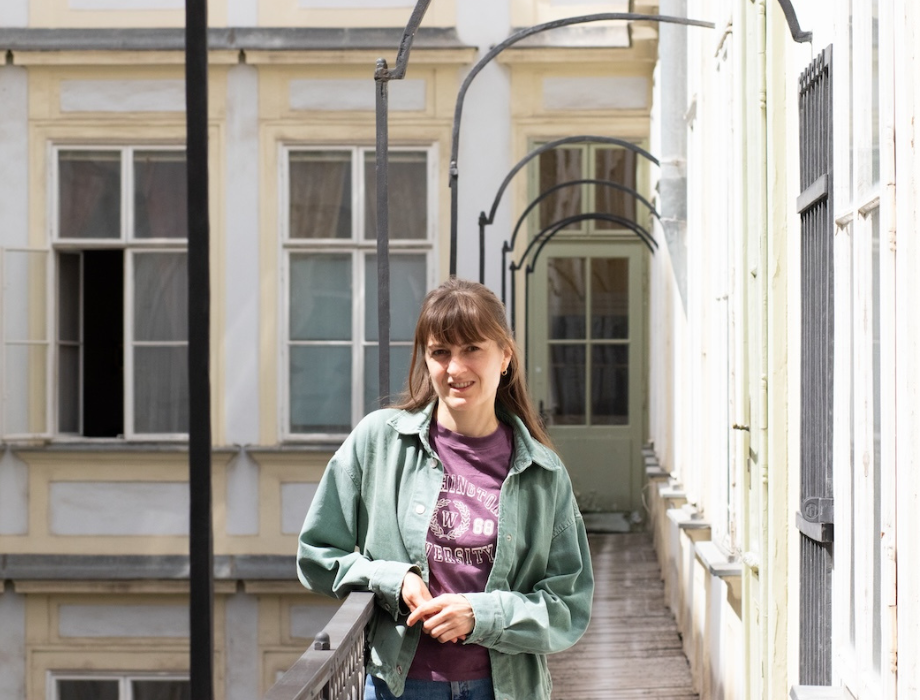
Photo: ÖGfL
The interview was conducted by Nathalie Weber.