

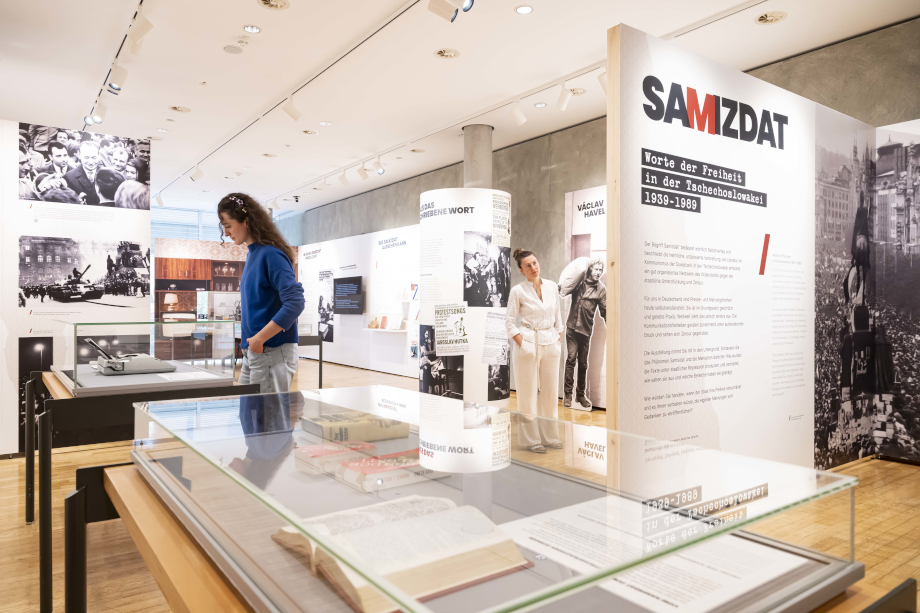
How did the idea for the exhibition come about? Who conceived it and who implemented it?
The original plan was to focus on technical means of communication and their Czech forms. When I first saw the Museum für Kommunikation in Frankfurt, I immediately fell in love with the building and thought to myself that, as part of Czechia’s Guest of Honour appearance, we absolutely had to organize an exhibition there.
We then met Frank Gnegel, the museum’s curator, in Vienna and discussed the concept of the exhibition together. But neither of us was really satisfied with the idea. And suddenly we realized that we were actually talking about freedom of speech – and from there, it was only a small step to the subject of samizdat.
That same evening, I called Michal Přibáň, who is probably the leading expert on this subject in our country today. We talked at length, and by the end of the conversation, the basic concept of the exhibition had already been established.
It then took another year for Michal and me to work out the final textual version of the exhibition, with the great help of our colleague Věra Böhmová, who also helped us gather the necessary materials. The Moravian Library then took over the preparation, and its partnership with the Museum für Kommunikation ensured considerable attention from the German public.
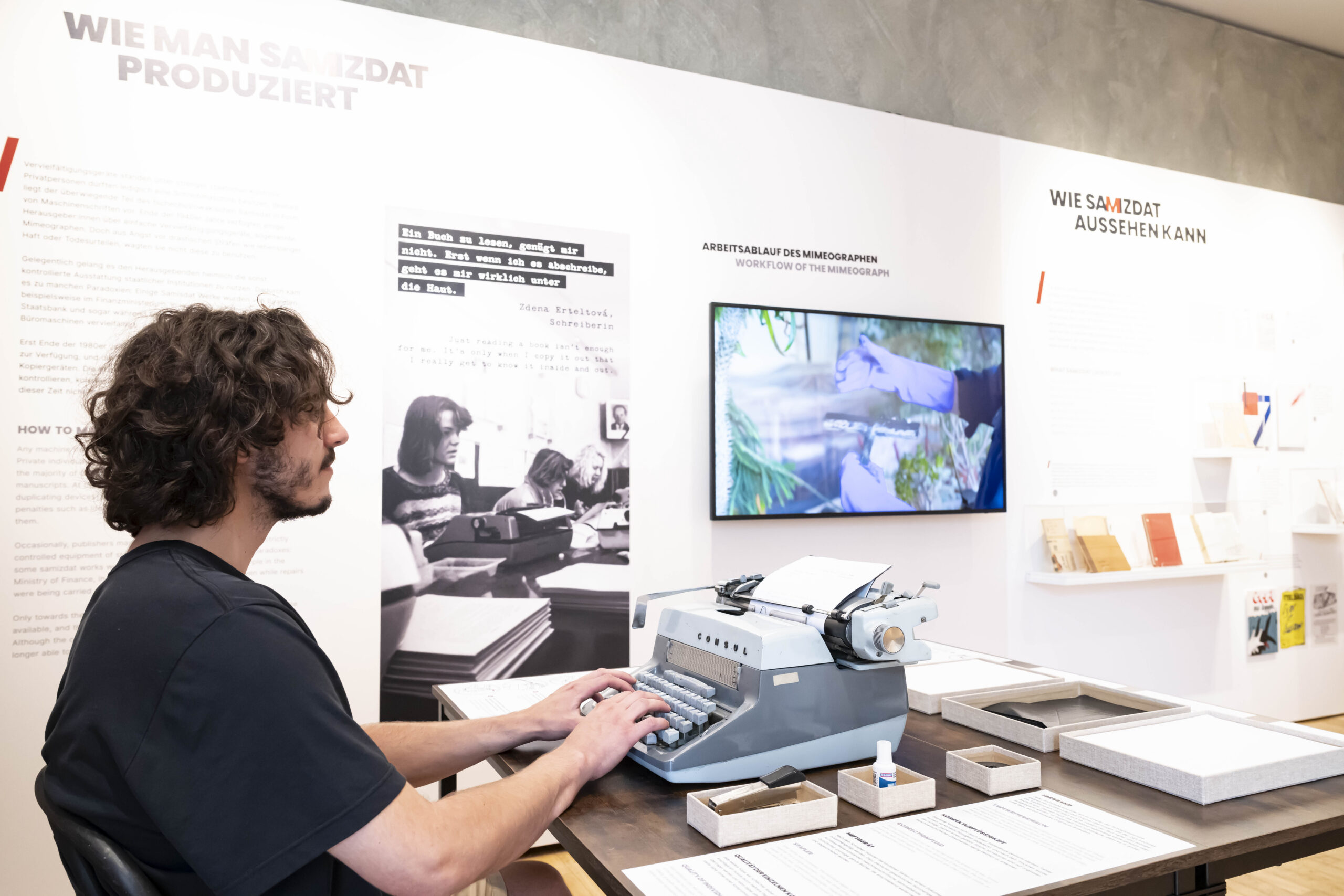
The exhibition also features some of the original machines. Where do they come from?
We are extremely fortunate that Prague is home to the specialist library Libri prohibiti, which collects samizdat publications not only from the former Czechoslovakia. Because of the size and particular nature of its collection, it has been part of UNESCO’s cultural heritage for several years.
It is headed by the wonderful Jiří Gruntorád, himself a former active member of the samizdat movement. He was extremely helpful and lent us an incredible number of unique documents, including duplicating machines.
He even agreed to make a short film with us, which visitors can see in the exhibition. It allows them to watch how these machines were used – which is by no means easy.
Is samizdat still relevant today? Why is it important to remember it?
Samizdat has several meanings. As a historical source, it is evidence of the fundamental social need for a free space in which ideas can become more pluralistic and a critical relationship with reality can develop. In this sense, it is also a testimony to courage and civic responsibility.
Václav Havel once said that samizdat is “life in truth”. In essence, he was saying that samizdat is not merely printed material, but above all an attitude – perhaps even an existential situation involving a choice.
And this brings us to another meaning of samizdat. Samizdat emerges when an ideology has sufficient instruments of power to ban or suppress other opinions or ideas.
We still live in a world in which different ideologies compete with one another. In such a situation, samizdat makes us aware of how fragile our public sphere is. At the same time, it represents a potential that will always remain available to us – provided that we have sufficient courage and civic responsibility.
Ultimately, samizdat also makes us realize that we should do everything we can to ensure that it is no longer necessary to demand the right to freedom of speech through such means – a right that is, or should be, a fundamental condition of human existence.
Is there a particular samizdat work or person associated with samizdat whom you especially value?
In fact, I value everyone who had the courage to become involved in this activity. Of course, there are famous figures such as Václav Havel, Ludvík Vaculík, or the underground poet Ivan Martin Jirous. But the movement as a whole would never have had any chance of succeeding without the involvement of a broad section of the public.
Samizdat is a community, a network that connects people. Personally, I was particularly fond of the authors from Olomouc who published the samizdat collections Listy přátel. My later mentor and friend, the poet Jiří Kuběna, also published there.
Another figure is Petr Oslzlý from Brno, co-creator of a particular form of samizdat, the underground gallery Drogerie – Zlevněné zboží. It was a project based on the concept of free exhibitions in an unfree society.
Petr Oslzlý later became an adviser to President Václav Havel and, until recently, served as director of the Centre for Experimental Theatre in Brno.
And then there is my friend from Prague, Filip Písařovic. Thanks to him, as a 17-year-old boy at the end of the 1980s, I became part of the network through which samizdat publications circulated.
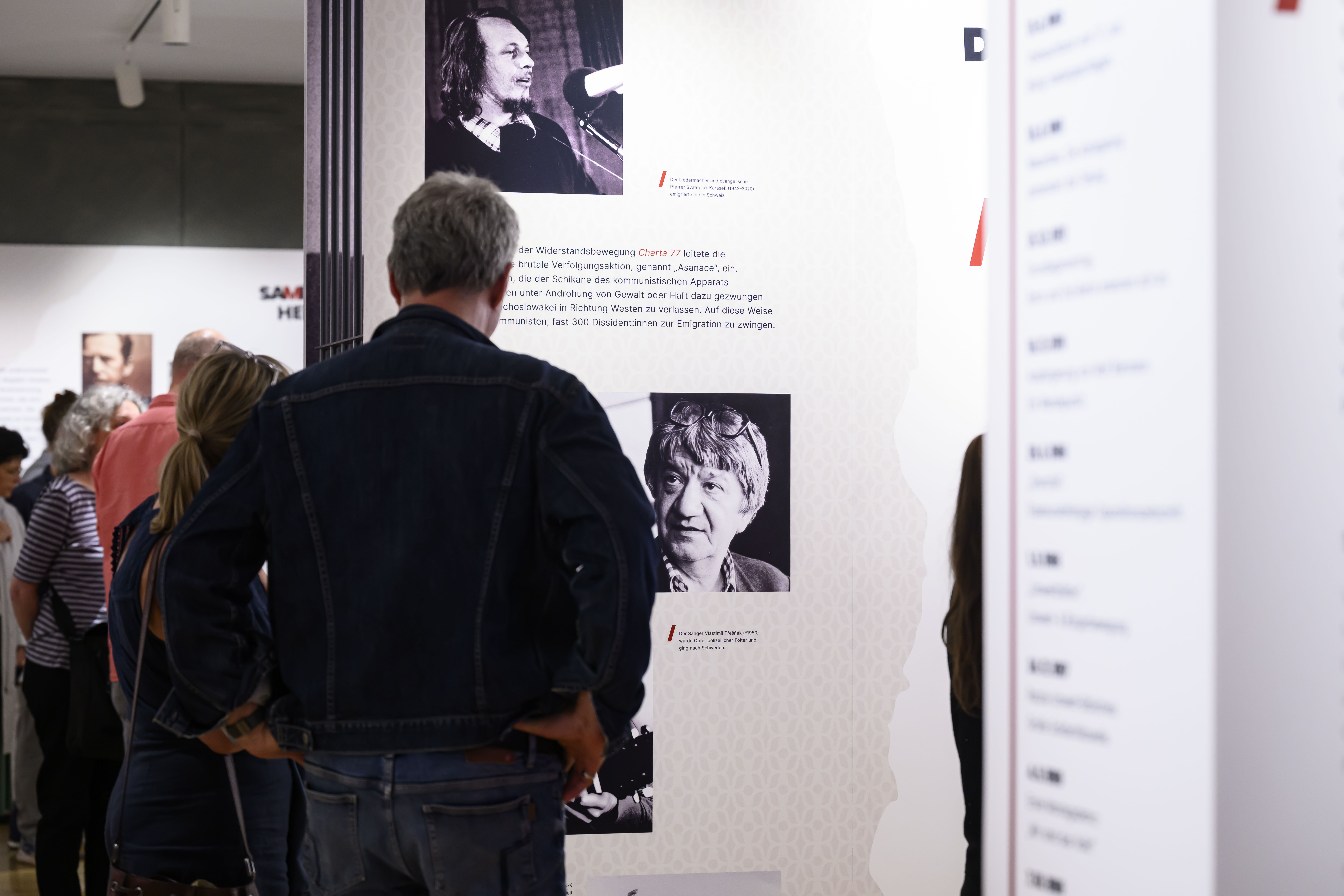
Is Czechia particularly known for samizdat? Is there anything special about the Czech samizdat tradition?
It would be difficult to say that there is anything fundamentally special about the Czech samizdat tradition. Samizdat is always associated with a certain degree of ingenuity – the search for techniques for reproducing written words or visual material. There was not, however, a great deal of variation in these techniques.
Samizdat is primarily not about the aesthetic quality of the printing, but about the content. There are exceptions, though. The poet Ludvík Kundera, Milan Kundera’s cousin, for example, published samizdat in the 1970s and 1980s that was instead characterized by a high level of graphic quality. Leading Czech visual artists and writers who were banned and whose visual or verbal poetics did not conform to the official norms of the time contributed to these publications.
Incidentally, Ludvík Kundera had already experimented with samizdat as a 22-year-old during the Nazi occupation. As a member of the Ra surrealist group, he and his friends were unable to publish officially, since surrealism was also considered “degenerate art” in the Protectorate of Bohemia and Moravia. They therefore published their poems and drawings in the form of so-called “black prints” – in other words, samizdat.
Ludvík Kundera called his samizdat production of the 1970s and 1980s Books, Non-Books. In a sense, these publications were a reminder of a similar practice from the wartime period.
How did you feel when you first saw the completed exhibition?
Every exhibition goes through several stages, and each one brings its own tension and anticipation. Once we had finally put together the textual version, which we discussed in detail with our colleagues at the Museum für Kommunikation – they helped us adapt it so that it would be comprehensible to German visitors with different historical experiences – we began thinking about its graphic design.
Our partner became Štěpán Drlík, with whom we had already created a number of exhibitions at the Moravian Library. Once again, we had long discussions about the various proposals. We were very impressed by his approach to the graphic design.
But a design is one thing, and its realization is another. When I finally saw the actual exhibition at the Museum für Kommunikation, I was thrilled. The realization looked even better than the designs. Everything simply came together to create a very beautiful whole.
Štěpán’s design greatly enhanced the exhibition, while at the same time the graphic concept does not feel the need to draw excessive attention to itself. I am very happy with the exhibition.
What have the reactions been like so far?
I was surprised by how positive they have been – both with regard to the content and to the way the exhibition has been realized. It is clear that the subject of freedom of speech resonates strongly with society. And that is a good thing.
I will be pleased if our exhibition contributes to reflection on the relationship between freedom of speech and individual civic responsibility, and if it encourages people to think about the fragility of the social situation in which we live.
Pictures: Museumsstiftung Post und Telekommunikation / Salome Roessle
The interview with Tomáš Kubíček was conducted by Annika Grützner and Karolína Tomečková.