

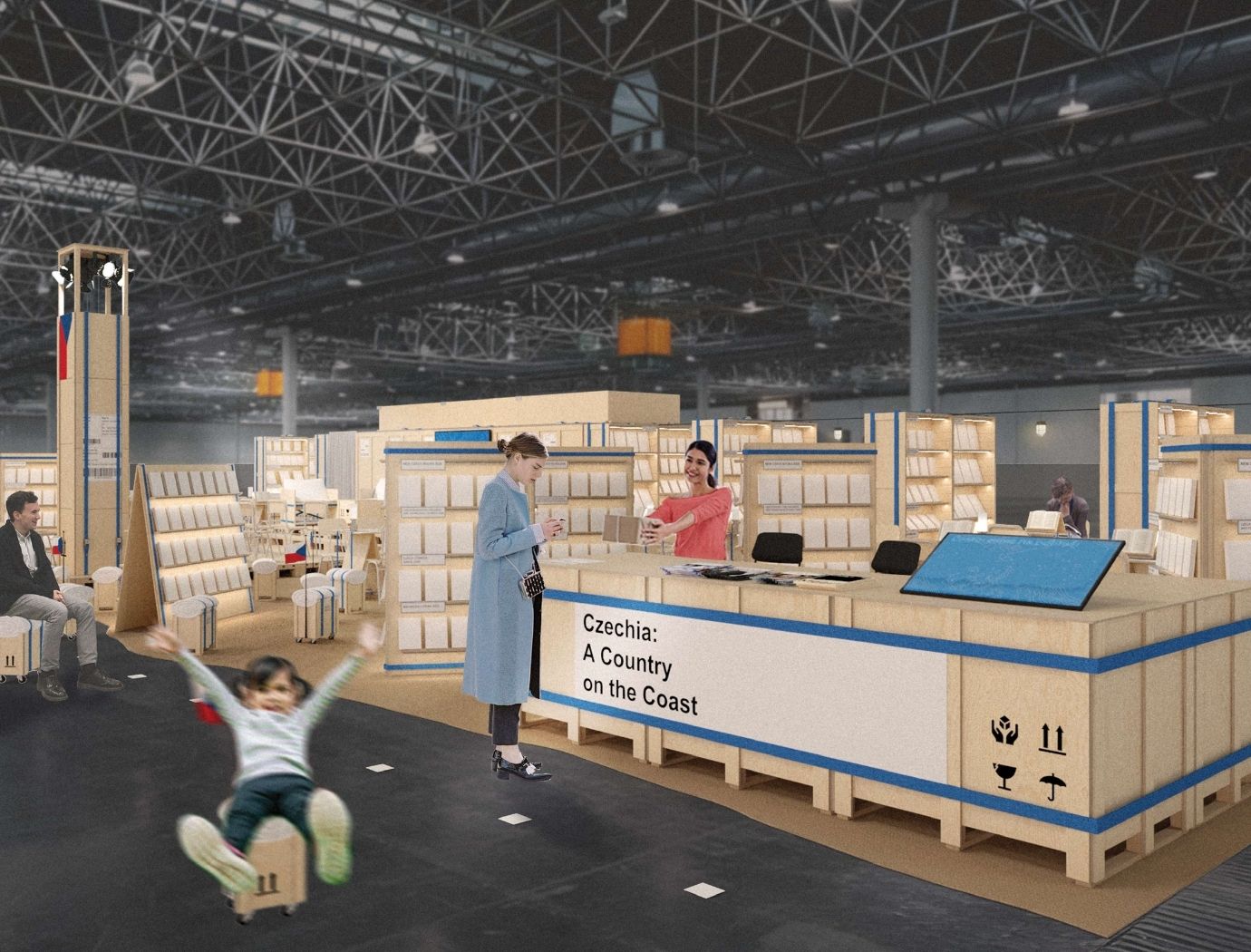
The stand is made up of crates, straps and metal components, giving it the appearance of a cargo ship. Why did you choose this particular design?
When we work on a design, we often find the answer in the brief itself. In this case, we drew heavily on the motto and the metaphor of the Czech Republic as a country on the coast. For us, the coast strongly evoked a harbour – a place of exchange and trade, where different cultures meet and relationships are formed.
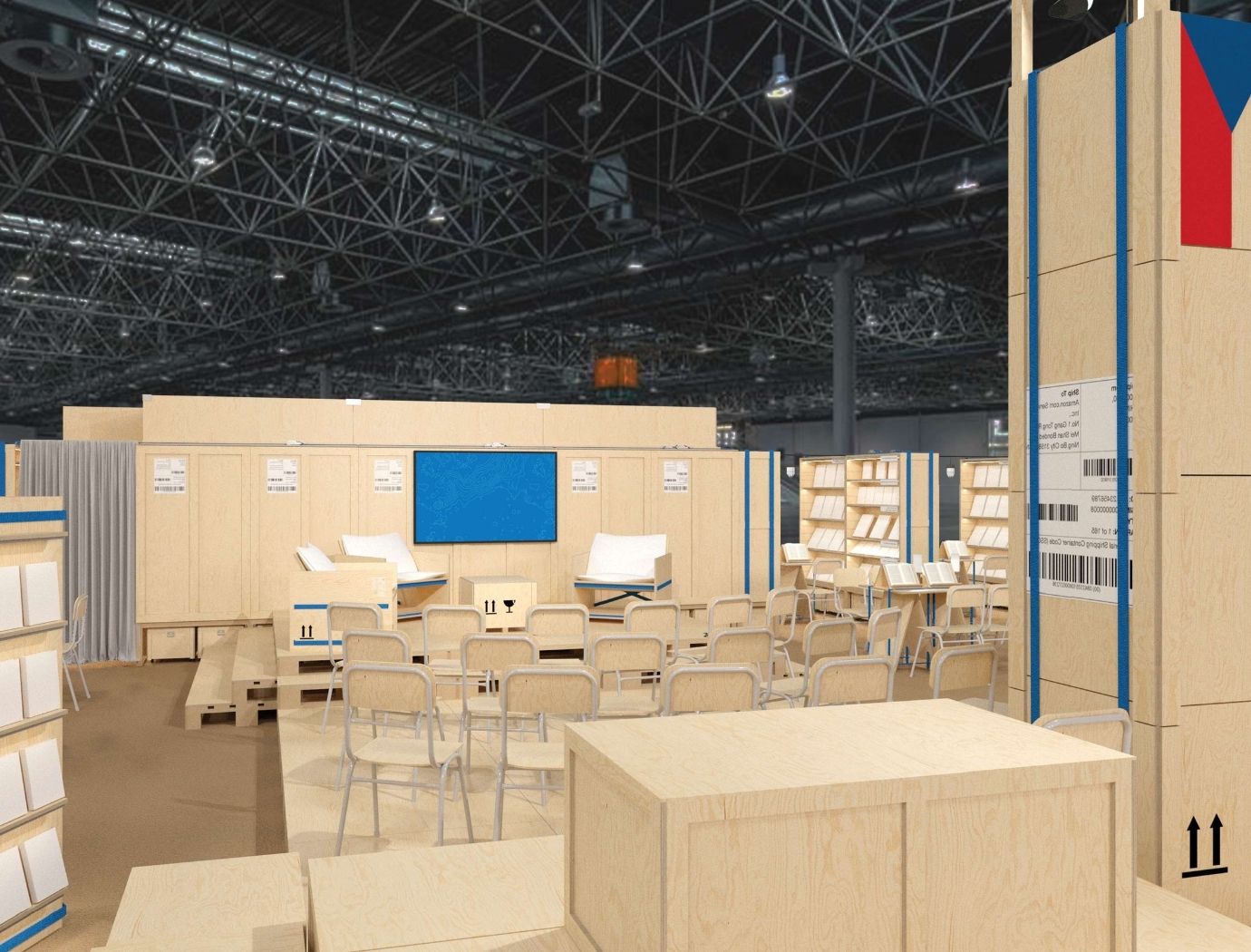
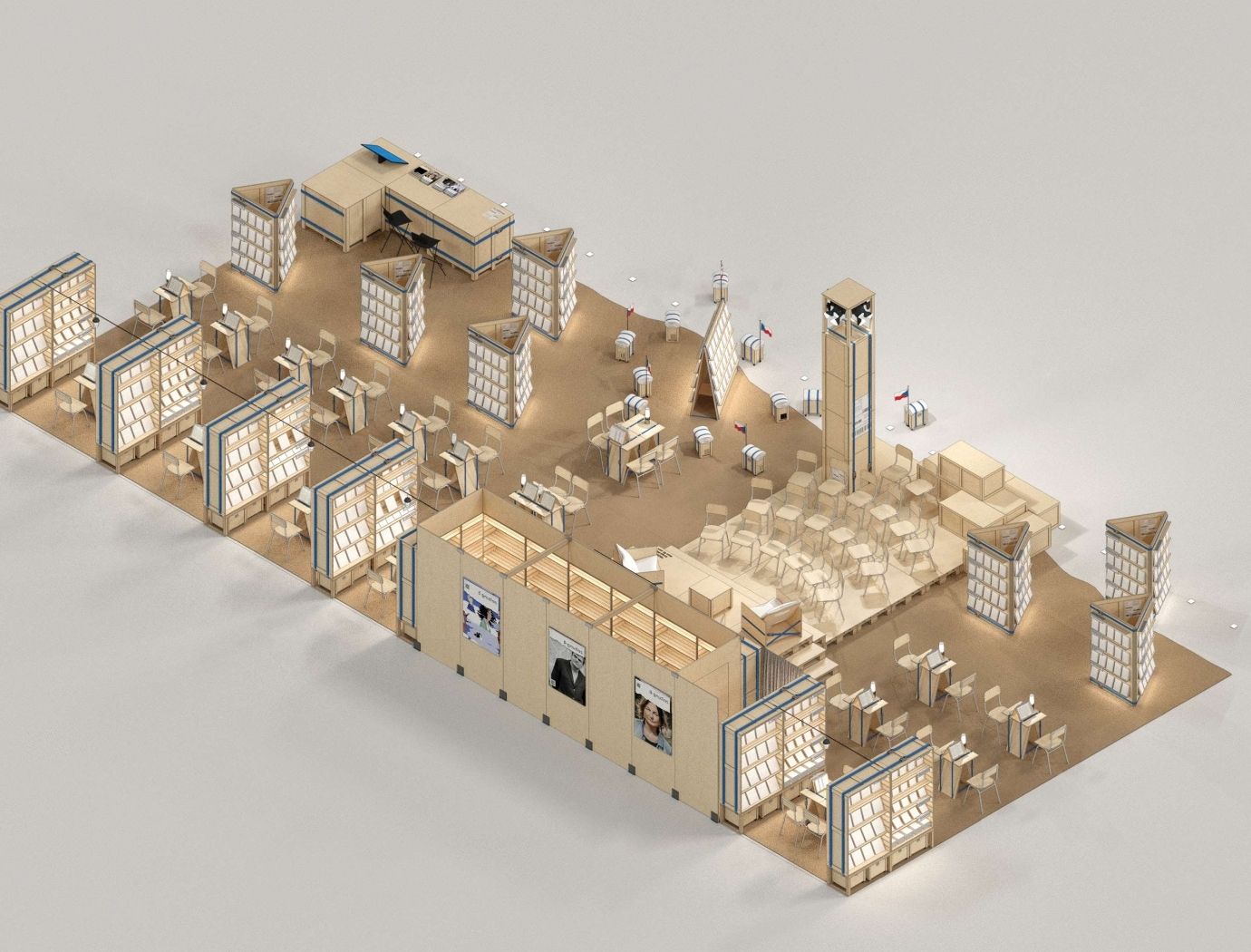
That’s why we took the metaphor quite literally and created a harbour. It features a lighthouse, a jetty and shipping crates. Books are brought to the site in these crates, which are then unloaded and transformed into bookcases. At that moment, the whole harbour really comes to life.
How did the fact that the stand will be used not only this year in Frankfurt but also in subsequent years, on a smaller scale, influence its design?
The stand we’ve designed is modular, so it can be easily adapted to any space. The basic module, from which the dimensions of all elements are derived, is one metre. For example, the information desk consists of sections up to four metres long, but in a smaller space, parts can be removed as required. Put simply, the stand works like Lego. We designed it so that the individual parts fit together, but at the same time can be easily dismantled, stored and transported for future editions.
What will the smaller version look like?
The final design of the stall depends primarily on the available space and technical requirements. There is a direct correlation here: the less space there is, the fewer books and bookcases there will be, the less storage space, and consequently the smaller the facilities. However, the design includes elements that are key to the stall’s identity and should remain in any version of it – a typical example being the iconic lighthouse.
Did you take the stand’s timelessness into account when designing it?
From our perspective, timelessness lies in the art of ageing. That is why we have made the stand from wood, which ages naturally and gracefully. We have given it the form of shipping crates, which will naturally bear the marks of use. Even the shiniest surface loses its lustre over time, and we don’t want to pretend that the stall will shine forever, painstakingly retouching every scratch and smudge every year. On the contrary, these marks can tell a story. Perhaps the journey of books sailing across a sea of culture?

In your design, you place great emphasis on sustainability and environmental friendliness. Why are these core values for you, and how do they specifically manifest in the design of the stall?
We regard these values as a given, and they are reflected in all our designs. They influence a great many decisions. In the case of the stall, this includes, for example, the choice of materials – wood as a renewable material with a clear life cycle – and the use of mass-produced components such as straps, handles and Euro pallets. It also encompasses the aforementioned modularity, relatively easy maintenance, reparability and the timelessness we mentioned.
The design also features a lighthouse. Is its purpose similar to that of a lighthouse at sea? Why was it important for you to incorporate it into the design?
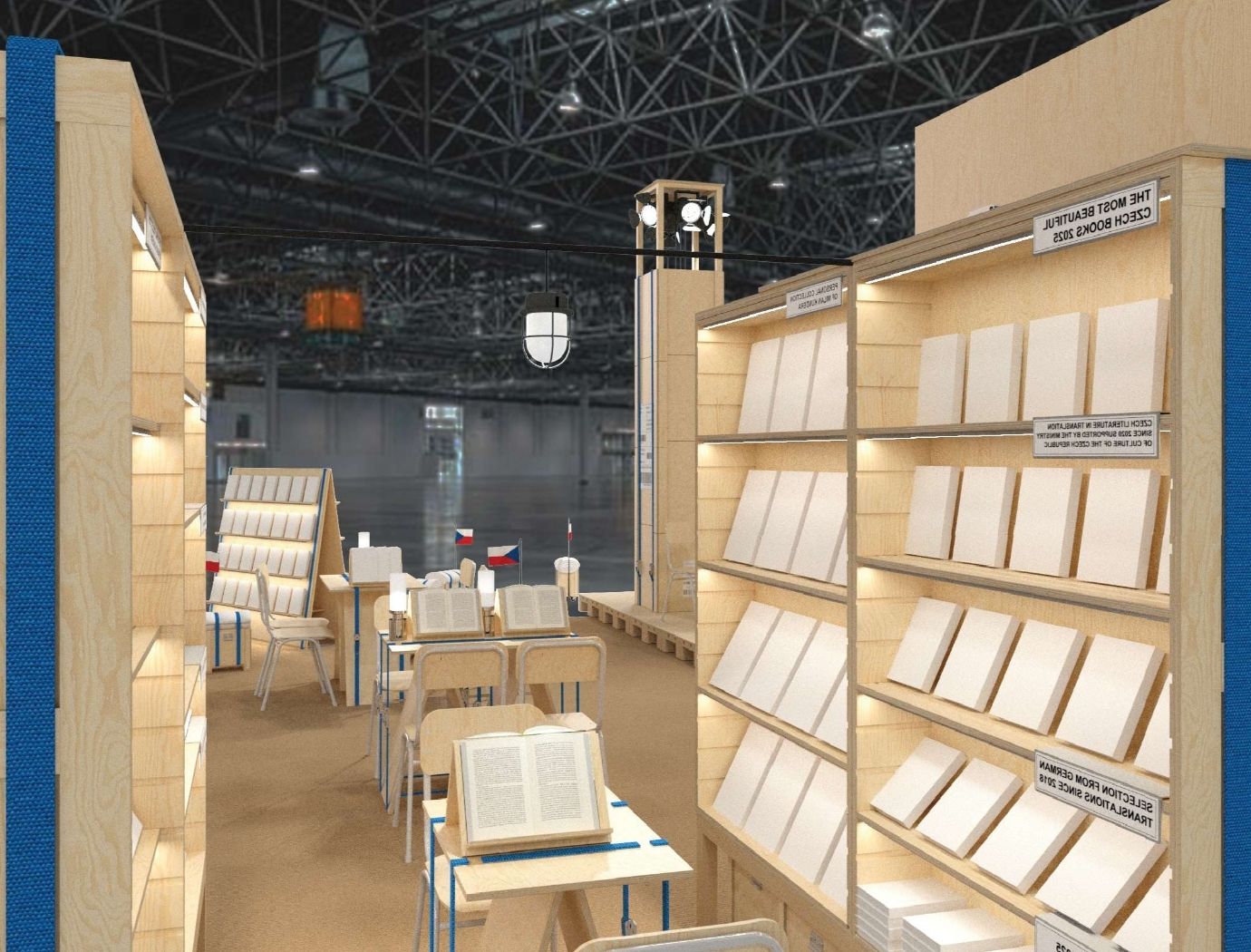
The lighthouse combines several functions: it is an easily recognisable symbol; it is a landmark – a navigational point that attracts attention from a distance; and at the same time, it provides general lighting for the stall, eliminating the need for costly suspended structures.
Where did you draw your inspiration from?
For us, the inspiration stemmed primarily from the metaphor itself. When we imagined the stand’s space as a harbour and a place of exchange, we gradually began to visualise what was happening there, what elements and materials belonged in such an environment, and how the whole process might work at the trade fair.
That idea then sparked further imagination. We pictured a visitor sailing in, spotting the lighthouse, entering the space and taking part in a kind of exchange – sitting opposite someone else, browsing through books and meeting others. In the end, perhaps they’d symbolically sail away again with their favourite book, perhaps even on one of the children’s boats.
At first, it was almost like a fairy tale to us. But it was precisely this story that helped us gradually bring the space to life. At the same time, we wanted the resulting stand not to come across as childish, even though imagination played an important role throughout the design process.
How did you find working with the event’s theme? Did it feel restrictive in any way, or did you, on the contrary, appreciate that it gave the presentation a clearer direction?
We think the theme actually guided us, and that it was good to have something to build on right from the start. It was important to us that there was already a vision in place that we could build on and draw inspiration from. Our design actually stems very directly from that theme.
At the same time, we thought it was good that the Moravian Regional Library had formulated that basic vision right from the start, so it wasn’t left to the architects to come up with the main conceptual idea from scratch. We are in an environment of books and literature, and in our view, that is precisely where the main idea should have come from.
Once we’d unpacked the reference to Shakespeare’s *The Winter’s Tale* and the idea of the Czech Republic on the coast, it all started to make a lot of sense to us. We saw it as a metaphor for the fact that the Czech Republic is part of a global ocean of literature, and that in literature, actual geographical boundaries are not really that significant. It was also important to us that this is precisely how the Moravian Regional Library wishes to present itself. We therefore wanted our design to convey this idea, and we took the metaphor almost literally.
What was the biggest challenge for you?
The most challenging part was bringing together all the requirements of the brief and transforming them into a design that would be cohesive whilst also conveying a particular idea.
What experience did you draw on? Had you carried out similar projects before?
Š: Whilst at university, Patricia and I designed an exhibition at Uherčice Castle. That gave us valuable experience, particularly through working with joiners.
Why did you decide to enter the competition?
F: I’ve worked with the Moravian-Silesian Regional Museum (MZK) on the layout and design of their stand in previous years. I worked on the concept and components based on architect Martin Hrdina’s design. Participating in the Frankfurt Book Fair, for which I produced an architectural report, was a very valuable experience. I personally enjoy working on exhibition-scale projects, and I’ve only recently started working at AVT. So I wanted to put all this experience to good use and create a high-quality project. I wouldn’t have been able to manage the whole thing on my own within such a short timeframe, which is why I invited two other colleagues to collaborate with me: Patrícia and Štěpán, for which I am immensely grateful. Naturally, our individual roles emerged as the project progressed, and we’ve complemented each other right from the start.
Will you be travelling to Frankfurt to ‘check’ the stand and test it in practice?
Definitely – it wouldn’t be possible otherwise. We don’t just want to go there to have a look; we’ll be there on business as well, and we’ll be fine-tuning a few minor points and details whilst we’re there. We’re pleased to be working with the stand-building company Exponex and that we can continue to sort these matters out as we go along.
After that, we’ll mainly be watching to see how the stand holds up in practice. We’re confident it will work, as we used our best judgement when designing it. But what we’re most looking forward to is the moment we see it filled with books and visitors. Only then will the vision and imagination we’ve been working with all this time truly come to life.
The design also includes little boats on wheels for children. Is it important to you that the stand is also accessible to young visitors? How did you come up with this idea?
When we were designing the children’s section and seating area, in our imagination we had long since been on the coast, building a harbour. It wouldn’t be a harbour without boats. All we had to do was add wheels and little flags to the crate stools, and we could already picture the children happily whizzing around the exhibition grounds. It was essential to us that the stand offered something for everyone, regardless of age.
What do you personally enjoy most about the stand? What’s your favourite corner?
We enjoy various things about it. We really like the lighthouse, even though we had our doubts about it at first. But precisely because it doesn’t have just one function and has several layers to it, it’s ultimately become one of our favourite features. We’re curious to see what it’ll actually be like to sit underneath it.
We also like the reading nook between the bookcases. You sit down there, with a lamp shining above your head, and the little lamp on the table is a bit like a candle. It’s a place where, surrounded by books, you can lose yourself in another world for a while.
The interview with the stand’s architects, Filip Bala and Štěpán Macko, was conducted by Karolína Tomečková.