

What kinds of things can be expressed in Czech that are difficult or impossible to express in German?
Czech is often much more flexible, playful, and adaptable than German. Specifically, the first thing that comes to mind are verb aspects: to express the difference between a completed, ongoing, one-time, or repetitive action in German, you have to resort to other means (such as adverbs). In general, there’s a lot of room to play with verbs—and not just verbs—in Czech. Thanks to the language’s flexibility, with its many endings and relatively free sentence structure, it’s also possible to rhyme much more naturally—or, let’s say, to create a different rhythm than in German—without it sounding contrived.
Does a character’s personality change when you translate them from Czech into German?
That should never actually happen—aside from the fact that the character suddenly speaks a different language. The character remains the same; they simply have different means at their disposal to express themselves and make themselves understood. Sometimes they have to say more, sometimes they use different imagery, but they speak in the same tone, with the same intention.
When you translate, do you tend to think in images, in meaning, or in words?
First, I have to visualize the image in my mind. I look at it, examine the source text, listen to the rhythm and flow, read between the lines, and then figure out how I can best convey the whole package to the other side—into another language and a different context—with as little loss as possible.
What’s particularly difficult about translating Czech humor into German?
To be honest, I get annoyed by all this harping on Czech humor, which often stands for a certain beer-fueled clumsiness. I’m also not really sure whether people laugh more in Czech than in German—or whether we’re just too firmly in the grip of traditional clichés. Sometimes I also get the impression that people laugh things off to avoid having to deal with them, or that boundaries are clearly crossed and disguised as humor.
But of course, it’s always a challenge to translate humor based on allusions, linguistic peculiarities, or specific local knowledge—a kind of unspoken agreement. But that applies to all languages.
Which Czech jokes don’t work at all in German?
Anything that is inherent to a specific language or (cultural) context is difficult; you often have to look for similar images and the like. And something else I’ve often encountered: In Czech, people mock or use irony to address certain political, historical, or even social contexts—for example, regarding World War II and German fascism—in a different way, simply because they approach it from a different historical and political perspective. But this also applies to other areas; the boundaries of what can be said sometimes vary greatly.
How has translating changed your own German?
I often move between languages, in a space of transfer. Translating has definitely influenced the way I view language—any language. When I translate, I also read very differently—much more intensely, more deeply, and in a more multidimensional way. As my esteemed colleague Kristina Kallert once said, translating is the ultimate form of reading.
What are you currently working on, and what will be your next project?
The volume “Und ich sah mein Gesicht”, a collection of poems by Petr Hruška (Voland&Quist), was recently published, and in the coming days, the novel “Handlungsstörung” by Emma Kausc (Zeitkind Verlag) will hit the bookstores.
I’m currently still working on a few books that will be published for Frankfurt. Two works of prose are currently being edited—the novels
“Radikale Bedürfnisse” by Tereza Semotamová (Voland&Quist) and „Ein Bogen aus Fabel“ by Anna Luňáková (Verlag Das Wunderhorn). Together with my colleague Daniela Pusch, we’re co-editing an anthology titled “Poežije” featuring contemporary Czech poetry, which we’re also translating alongside other colleagues (edition.fotoTapeta). And the final project for Frankfurt is the translation of poems by Iryna Zahladko.
In addition, there will be readings and other events. One wonderful project I’m looking forward to this fall is a collaborative performance with the duo Stock-Wettin and composer Friedemann Stolte, in which translated Czech poetry meets contemporary composition and music. I’m really looking forward to that as well.
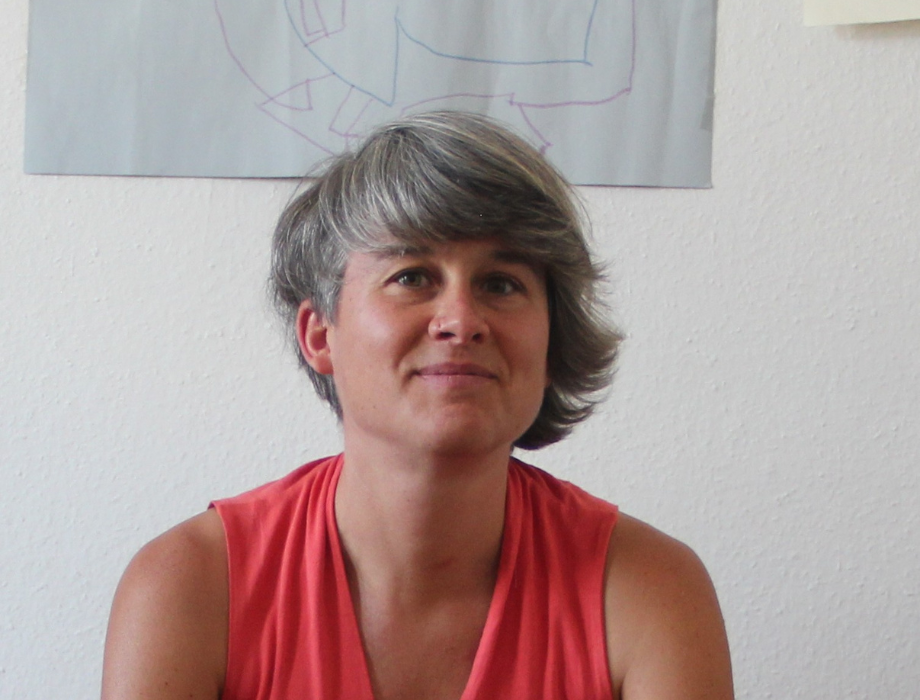
Photo: Paul Jeute
The interview was conducted by Nathalie Weber.