

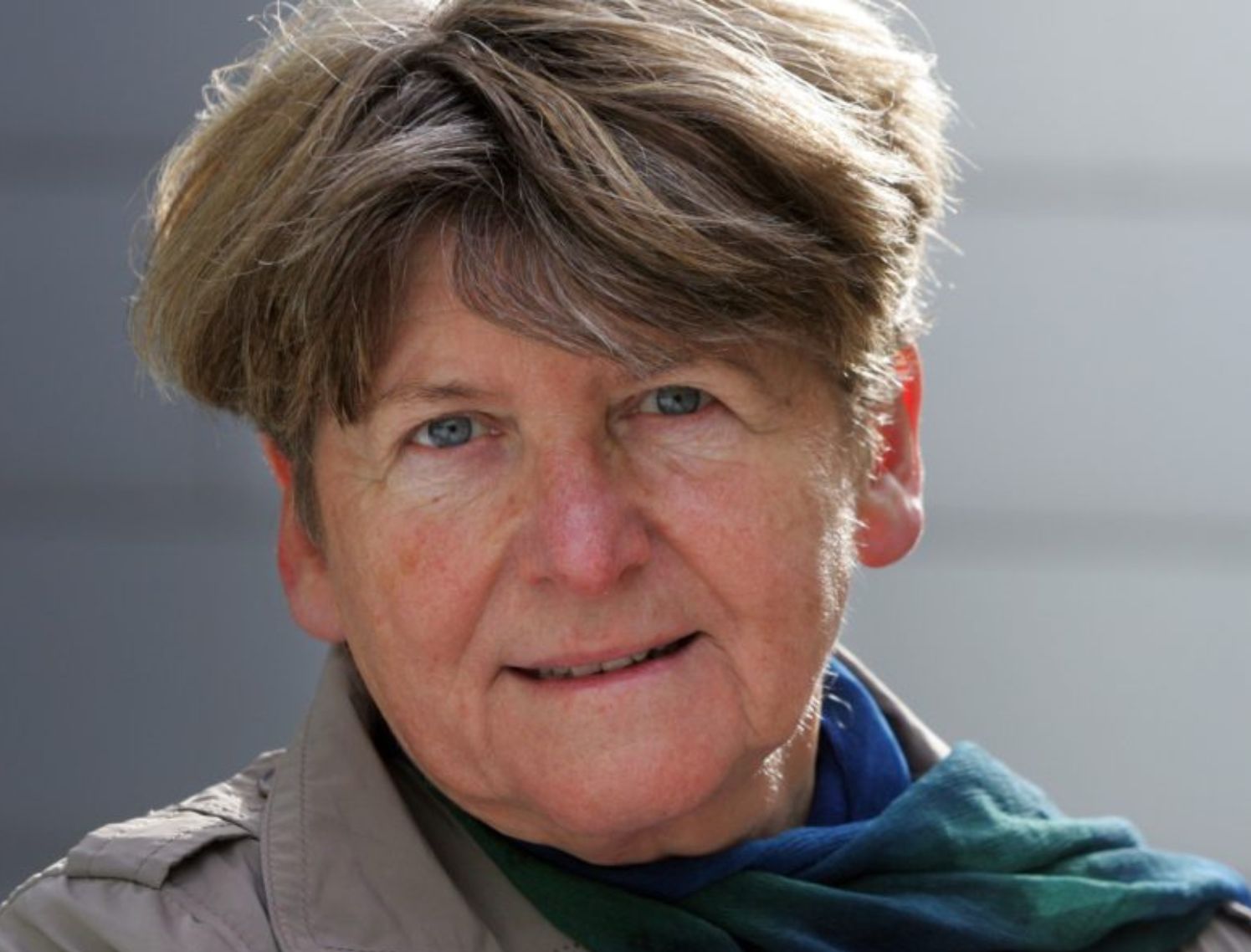
A few years ago, I had the honor of conducting a lengthy interview with her. I often recall our conversation, as it was fundamentally formative for me—as it always is whenever I’ve had the chance to meet a mature, exceptional woman who, through her years of experience, has shed light on everything I had previously only sensed. I can therefore say with a clear conscience that this interview, conducted a few years ago and updated for the honoree’s special anniversary, remains relevant to this day.
Has your membership in the “Šestatřicátníci” (Thirty-Sixers) literary group shaped you?
Certainly. I come from that generation—specifically from Brno’s “Šestka.” But with different connotations. I’m certainly more left-leaning than Pavel Švanda or Václav Havel; the ideas of socialism were closer to my heart, even though I was, of course, never a party member. But I come from a Protestant background, and there, issues of social justice were a central part of our lives. That has left its mark on me. And so has the fate of my generation: the later reformist communists were, so to speak, our teachers of Marxism-Leninism at a time when they were still in their dogmatic phase. They passed Marxism on to us as a system of ready-made truths, and our task was to keep our mouths shut and toe the line. And I think that—not just for me—left us with a sense of futility. Society was already set in stone, and we were supposed to just obey. Yet we—as young intellectuals—wanted to play a part in shaping it. That was also a problem for us, the “Šestatřicátníci”. In the 1950s, there was a period of discussion there about so-called activism. I remember sitting with Ivan Koreček on the banks of the Vltava, swimming and talking about whether it was possible to influence the system by somehow fitting into it.
And what’s your opinion on that?
As an active person, I felt closer to changing the system through critical engagement with it.
Some members of the “Šestatřicátníci” have already published their memoirs. How do you view them?
They’re written too much from the perspective of the year 2000 and Václav Havel’s presidency. And because I’m familiar with the early days of the “Šestatřicátníci”, I can see what’s missing there.
What’s missing?
After reading the memoirs of Jiří Kuběna and Pavel Švanda, as well as Pavel Kosatík’s book about the “Šestatřicátníci,” I found myself thinking that—even though I’d never intended to—I might write my memoirs after all. Because a woman’s memory is different. From the very beginning, men build their future standing in the world. I sense this even in the Havel–Kuběna correspondence. And then there are some inaccuracies. I was keeping a diary at the time, so I know, for example, that the Brno “Six” met a year earlier—specifically on May 24, 1952, at Petr Wurm’s place—than Kuběna states. He joined us a little later, when the two high schools merged, and subsequently enriched our group with connections to Prague. This gave rise to the code 36/6. After graduating from high school, however, I was the only one who went on to study the natural sciences, and I practically lost contact with the “Šestatřicátníci.”
Another point I’d like to address is the position of women in that group. They were, in fact—to quote Simone de Beauvoir—somewhat the “second sex.” No one discriminated against us, but the men set the tone. They had the right to interpret the world. We did not. At least, that’s how I felt. I don’t know how later members of the “Šestatřicátníci,” such as Věra Linhartová or Viola Fischerová, felt about it; I’d say they adapted more than I did. These are nuances, but very significant ones. Interestingly, reviewers of Kosatík’s book on the “Šestatřicátníci”—such as Lenka Jungmanová and Michael Špirit—noticed this. So I guess I didn’t exactly make up that whole “second sex” thing.
Women of our generation, even as intellectuals, simply had two options: to adopt the male interpretation of the world and adapt to it, or to accept loneliness. Many women do adopt the male interpretation of the world—and then they are accepted and achieve success. I didn’t play that game, and I think my friends sensed that at the time and found it irritating. We liked each other, of course, but I was the rebel—not a vestal virgin, but Athena.
If I apply this more generally to Czech female intellectuals of the second half of the twentieth century, then the novelist Libuše Moníková, for example, did not accept male role models, nor did Saša Berková, who, I think, paid a heavy price for it, even though she was considerably younger than we were.
Is that still true today?
Today it’s simpler. Or more precisely: women now realize that their view of the world is different, that they perceive different aspects of human existence. And they’re now more able to embrace that difference. The female perspective isn’t superior to the male one; rather, it’s different, and only the combination of both perspectives allows us to grasp the complexity of the world. It’s like stereoscopic vision—which, after all, is only possible with both eyes. The male and female perspectives on the world complement each other.
You’re the author of several books devoted to German anti-fascists; I’d like to mention, for example, the remarkable book “Helden der Hoffnung” (Heroes of Hope). You wrote a report on the Sudeten Germans for the magazine “Plamen” as early as 1969. Do you still remember what kind of response the report received?
As far as I know, the GDR protested against the report, and this was supposed to be one of the reasons for banning “Plamen”—or rather, one of the pretexts for its ban. It was a literary report and appeared in the magazine’s last two issues, namely issues 3 and 4 of the 1969 volume.
During the Prague Spring, the issue of the expulsion of the Germans began to be discussed publicly for the first time, for example in the pages of the magazine “Host do domu”. And my reportage on the remaining Germans in the Šumava Mountains, titled “Every Tree Rustles Differently”, fits into this line of discourse. To be honest, I’m a little proud of it.
You’ve been addressing the issue of the forced expulsion of the Sudeten Germans for several decades now. It’s also a question of searching for a new home, a new identity. In 1969, you married a German and moved to Germany. Is this also a central theme for you?
Of course. Where is my “we”? I don’t have a German “we”; I can’t and don’t want to say “we Germans” because I’m Czech. But at the same time, I live in Germany. I’d say my identity is multi-layered: as a person, as a woman, as a Czech woman living in Germany. And in the Saarland—I discovered this identity when the steel mills and mines began to close. Suddenly I realized that a part of my new home and identity was disappearing along with them. I truly wept over it. Having multiple identities is a great gift. I received the first one at birth; I worked hard to earn the German one, and that’s why it’s dear to me. I don’t feel any conflict between them. They just come into play with varying intensity in different situations.
You’re also known as a sociologist with feminist views. In the 1970s, you wrote and published a book in Germany about women under socialism. Would that socialist study of women have come about if you’d been living in Czechoslovakia at the time?
Probably not. Even though I was already interested in women’s issues as a member of the “Šestatřicátníci”. And here lies the paradox: when I arrived in West Germany, I was struck by the absurd realization that, as a woman, I had been far freer in Czechoslovakia than in democratic Germany. Not as a citizen, but as a woman! In Germany, I was defined by my husband’s social status. The kind of underestimation of women that prevailed in Germany at the time radicalized me. That’s why I wrote that book—I also felt the need to present the socialist model of emancipation to the Western world. Today I have to admit that I viewed the Czechoslovak situation in many ways more positively than it actually was. A whole range of more hidden aspects of discrimination only became apparent to me after 1989.
Such as?
That it wasn’t about the liberation of women, as Marx had envisioned it, as part of the general emancipation of humanity, but merely about the liberation of the female workforce.
| ALENA WAGNEROVÁ She was born in 1936. She studied biology and education, and later earned a degree in theater studies through distance learning. She began publishing in the second half of the 1960s. She has lived in Saarbrücken, Germany, since 1969, and has also lived part-time in Prague since 1989. She writes primarily sociological studies, literary essays, prose, and plays. She made her debut as a prose writer with the novella “Dvojitá kaple” (published in German translation in 1982, in Czech in 1991). Her works published in German and Czech include, for example, a biography of Milena Jesenská, a book on Franz Kafka’s family, and two volumes of interviews with Germans and Czechs from the Sudetenland. She has published a book in German on the life of Sidonie Nádherná (to be published in Czech next year). This fall, the Berlin publishing house Aufbau published Alena Wagnerová’s book “Helden der Hoffnung” (“Heroes of Hope”), a comprehensive volume of fifteen portraits of German anti-fascists from the Sudetenland. |
You have also studied the work of the German-writing Czech novelist Libuše Moníková. How would you characterize her work, which, incidentally, is much better known in Germany than in the Czech Republic?
In her debut novel “Eine Schädigung” (“Újma”), Moníková was the first female prose writer in the Czech context to address violence against women as part of institutional, systemic violence. And it is interesting that Czech female critics have remained silent on Libuše Moníková’s feminism. I remember how Moníková, in one letter, compared the discrimination against Jews to that against women. But her greatest achievement was elevating the issue of the Czech condition to a European level—she filled the world with wandering Czechs discussing the problems of Czech history. Of course, she based her work on the division of Europe and also relied—especially later on—on various clichés: Kafka, Smetana, Němcová… Certainly, she needed to cater to the needs of a German audience as well. That is also why, in “Pavane for a Dead Infanta”, she suspended her own story of a young Czech intellectual who finds herself in German society and is offended by its banality and consumerism. And then a turning point occurs: Kafka appears, and the author begins to tell not her own story, but someone else’s.
How often did you travel to normalized Czechoslovakia?
Once or twice a year. It was terribly sad to experience that deep frustration, hopelessness, disintegration, and moral nihilism, and then suddenly find myself at the airport in Frankfurt. How many times did I tell myself that if I were an emigrant and not allowed to travel to the republic, it might be better for me than witnessing such a decline in my homeland.
Did you socialize with Czechoslovak emigrants in Germany?
Hardly, because many of them were—figuratively speaking—my former teachers of Marxism-Leninism. It took me a few years to overcome my mistrust and prejudices and to genuinely come to love people like Jiří Pelikán and Vladimír Blažek.
You often and gladly work as an oral historian; in the Czech Republic, you’re one of the pioneers of oral history. How did you get into it?
It’s connected to my early days as a writer in the 1960s. In the 1950s, reality had to conform to ideological premises. In the following decade, a process began of discovering what society was really like—a process of reconstructing reality. Reportage was the form that best facilitated this, thanks to its immediacy, authenticity, and documentary nature. I also made my debut as a writer by penning reportages for “Plamen”. I was fascinated by talking to people, learning what they thought, what their lives were like, recording it, listening to them, and understanding the times. And so, step by step, I found my way to oral history. Elements of it were present in my reports; however, my first oral history books were “Odsunuté” and “Neodsunuté vzpomínky”. “We fell in love with the facts and turned them into literature,” said the writer Jiří Weil. I could certainly agree with that. For me, the most important thing about oral history is that it cuts across ideological frameworks and de-ideologizes history. Because an individual’s private life is the first thing that ideology and totalitarianism take away from them. As a proper comrade, I could never have fallen in love with a West German—at most, with a citizen of the GDR.
After 1989, I took part in a major project called “Women’s Memory,” and now there’s a major effort underway to document the fates of Sudeten German anti-fascists.
What does your work look like in practice?
The basic rule is to let the first part of the interview unfold naturally, but that doesn’t always work out, because not everyone knows how to tell their story. But the most important prerequisite is knowing how to listen, to notice the tangents that arise in every interview. And to ask open-ended questions rather than leading ones. An atmosphere of trust is crucial. And to realize that when someone entrusts you with their life story, it is a gift that you must not abuse.
In your book “Helden der Hoffnung”, you describe the unassuming yet heroic lives of fifteen Sudeten German anti-fascists. Do you have any desire to follow up with stories of Czechs and Germans from the border regions who behaved badly?
I’d like to. When I was writing “Suppressed Memories”, I hoped that perhaps some of the Czechs who had committed crimes, been cruel, or tortured people would come forward. No one did. For any of those people to come forward, they would have to be certain that it would be an open conversation—one focused not on condemnation, but rather on understanding what leads to such acts. And Czech society still tends to condemn and think in black-and-white terms. Of course, this is also a problem of linguistic tools—the ability to express oneself in a nuanced way. Czech journalism, with its sensationalism and tendency to oversimplify, doesn’t exactly set a good example in this regard. Recently, however, I was pleasantly surprised by journalist Petr Zídek’s nuanced report in Lidové noviny about prosecutor Brožová; he went back to her youth and sought the causes of her later development. I think that only through such an approach can we come to understand what has been happening to us over the past twenty or forty years.
And how would you “nuance” your understanding of the Czechs who participated in the excesses of the violent expulsion?
I can’t say; I suppose I’d look for reasons as well. But oral history doesn’t judge—it merely records. I have a Czech acquaintance from the Sudetenland who, I believe, ran quite amok after the war. Today he’s a neurotic and an alcoholic. I suspect this is connected to what he did as a boy. Essentially a decent person who temporarily lost his mind and his inhibitions—and thus paid the price.
Did German anti-fascists ever compare the actions of the Freikorps—that is, the German right-wing paramilitary units—with those of the Czechoslovak Revolutionary Guards?
Absolutely not! They are politically minded people with a strong sense of German guilt. And while they condemn the rampages of the Revolutionary Guards, they understand them as a consequence. They also never see themselves as victims, because they behaved as active agents, not passive objects of history. They are not bitter, even though they have endured two historical defeats—those from the GDR even three… One of them, for example, told me: “You know, it was bad that we had to leave. But when I think of my two Jewish classmates who were sent to the gas chambers at Auschwitz, I tell myself that, compared to that, nothing really happened to us.” I have immense respect for these attitudes.
Did anti-fascist-minded women and men perceive the postwar situation differently?
Not really. But I’m glad you asked. Because the political left is characterized by a high level of political engagement among women—all the way up to the level of female members of parliament and senators. Even during the war, women were practically the ones carrying out small acts of assistance for prisoners of war, forced laborers, concentration camp inmates, and so on. Is it already resistance—or not yet—when you refuse to accept the rules of conduct dictated by a dictatorship for which even giving a piece of bread to a prisoner of war is a criminal offense?
However, that was no guarantee that after the war they would receive an anti-fascist certificate and be allowed to stay.
Practices varied greatly. Those who were imprisoned in concentration camps were recognized as anti-fascists. But the “minor” acts of assistance mentioned above were sometimes not recognized, even though their humanitarian significance is considerable. When you’re in need and someone helps you, you never forget it. Even Sudeten Germans, after many years, still remember the Czechs who helped them after the war when they were suffering.
Your book was originally supposed to be titled “And Forgotten, We Will Go Down in History”. Why did you change the title?
The German publisher rejected that title. The Czech edition, however, will be published under the original title.
In September, a permanent exhibition on German anti-fascists opened in Ústí nad Labem. There was criticism in the media that the leader of the opposition and former Prime Minister Jiří Paroubek did not attend the event. Did his absence upset you?
I appreciate Paroubek’s initiatives to finally recognize the contributions of Sudeten anti-fascists, but I didn’t miss him in Ústí.
Was it your discovery that between ten and twenty percent of the Sudeten German population were anti-fascists, rather than five percent, as had previously been reported?
This is the result of research conducted by many people. And it’s also a matter of definition. The percentage of active participants—that is, those who voted for a party other than Henlein’s in the municipal elections—was about eight to ten percent. Many people boycotted the elections, which, given the political and economic pressure, was also a noteworthy act. So we can certainly speak of that ten percent.
How many stories of Sudeten German anti-fascists did you film?
There are nearly sixty of them—in fact, we have nearly a hundred interviews of varying lengths. Most of our narrators were born between 1920 and 1933. Their stories typically capture the lives of three generations—their grandparents, parents, and themselves. Most of them were involved in their parents’ political life from an early age, so they remember a great deal. Our oldest interviewee was born in 1913.
How do you process the material further?
The transcript is, of course, accurate and complete. For a scholarly publication, the interviews must remain practically in this state, perhaps with only minor editorial adjustments. But readers wouldn’t read the interviews in this form. For a reader’s edition, it is necessary, on the one hand, to preserve their authenticity, but on the other hand, to edit them. Such editing must not alter the meaning of the text—that is a matter of ethics. Narrators sometimes make mistakes in historical details, which can only be corrected in footnotes.
What criteria did you use to select the fifteen life stories for the book?
I tried to capture a representative cross-section of stories from various regions. I wanted to include Social Democrats, as well as those who served in the Czechoslovak Army in the West, and also those who fought in the Soviet Army. We’re missing, for example, Catholic clergy—who were a significant group—but unfortunately, without direct relatives, they’re difficult to trace. The two main groups consist of postwar resettlers to what later became West Germany—mostly Social Democrats—and then to what later became East Germany—where, logically, they were Communists.
Can you recall a story that didn’t make it into the book but was still worth recording?
Take, for example, the story of a woman from what was essentially a Czech family who did not declare her nationality in the 1931 census because they considered themselves internationalists. However, officials recorded their nationality as German, so they were subsequently automatically considered German. That woman had an extraordinarily dramatic fate, because, as the descendant of an anti-fascist, she was assigned to work as a telephone operator at the airport in Hradec Králové, where terrible things were happening—women were being raped there, and so on. After the war, the entire family had to move to the Soviet occupation zone; there, she fell in love with a Soviet soldier, had a child with him, and he was sent back to Russia because of his relationship with a German woman. She earned a degree and worked as an interpreter; as a staunch communist, she interpreted at a number of international party conferences in 1968, and after the occupation, she helped publish a fake edition of “Rudé právo” in Dresden. At the same time, her son attempted to flee to the West; he was caught and sentenced to four years in prison, and she didn’t see him for a total of eight years. Today, she doesn’t understand some of her own actions and lack of critical thinking.
Did anyone turn you down?
Just one man—out of fear of neo-Nazis in East Germany. However, all anti-fascists view neo-Nazis as a threat. Otherwise, most of them were happy that Czechs were finally beginning to take an interest in their fate. Actually, they’re all German Czechoslovaks. For example, on October 28, I called Mr. Löwit in London—a former soldier in the Czechoslovak Army in England—and it was he who told me in Czech: “Today is our national holiday.”
Have you received any critical feedback about the book from the Landsmannschaft?
Not yet. I’m curious about them because the topic of anti-fascists who identified with the Czechoslovak state contradicts the explanatory framework of the Landsmannschaft, which holds that, due to ethnic oppression, the Sudeten Germans could not identify with the Czechoslovak state and therefore supported Henlein.
Do you consider the topic of the Sudeten Germans closed for you?
Human life is never closed; that’s also been our experience with this project. It keeps opening up to us—new eyewitnesses are coming forward, and we’re discovering new facts. One of the eyewitnesses asked me just recently how we plan to conclude the project, and he pointed out that the Spanish government has granted honorary Spanish citizenship to all members of the International Brigades. It’s a valid question. But in what form should we express the Czech people’s gratitude? For a long time now, I’ve been thinking of something akin to the Avenue of the Righteous, through which we could thank all those who dared to go against the tide—that is, both the German anti-fascists and other righteous individuals from the German ranks who helped Czechs, prisoners of war, and forced laborers during the war, as well as the Czechs who, in turn, helped endangered Germans after the war.
A few years ago, your remarkable work on the life of Sidonie Nádherná was published in Czech. Following your biography of Milena Jesenská and your book about Franz Kafka’s sisters and mother, this is yet another biography of a woman. What drew you to her story?
When I was at the castle in Vrchotovy Janovice in the 1990s, where Sidonie Nádherná had lived, I realized that perhaps three hundred meters from the place where her Austrian friend Karl Kraus wrote his play “The Last Days of Mankind”, there had been a very brutal concentration camp during World War II, when the Germans turned the entire region between the Sázava and Vltava rivers into an SS weapons training ground. So, twenty-five years later, “The Last Days of Mankind” were indeed taking place here. It was a terrible realization.
My second source of inspiration was Sidonie Nádherná’s wartime letters to Václav Wagner, published by Jaromír Loužil, in which I came to know Nádherná as a courageous woman who fearlessly fought to preserve the castle and park—not as property, but as a work of art that holds value in and of itself. Beauty as something liberating that need not derive its justification from its utilitarian value! It seems to me that Sidonie Nádherná’s stance—with this emphasis—is exceptionally relevant today, when we value only what brings immediate benefit, and that it highlights the close relationship between aesthetics and ethics. Utility-driven thinking ultimately always ends in barbarism. This is evident in Janovice as well, where the Nazis managed to transform one of the most beautiful corners of Bohemia into a military training ground crisscrossed by a network of concentration camps.
Featured photo: Karel Šanda
Interview with Alena Wagnerová conducted by Dora Kaprálová.