

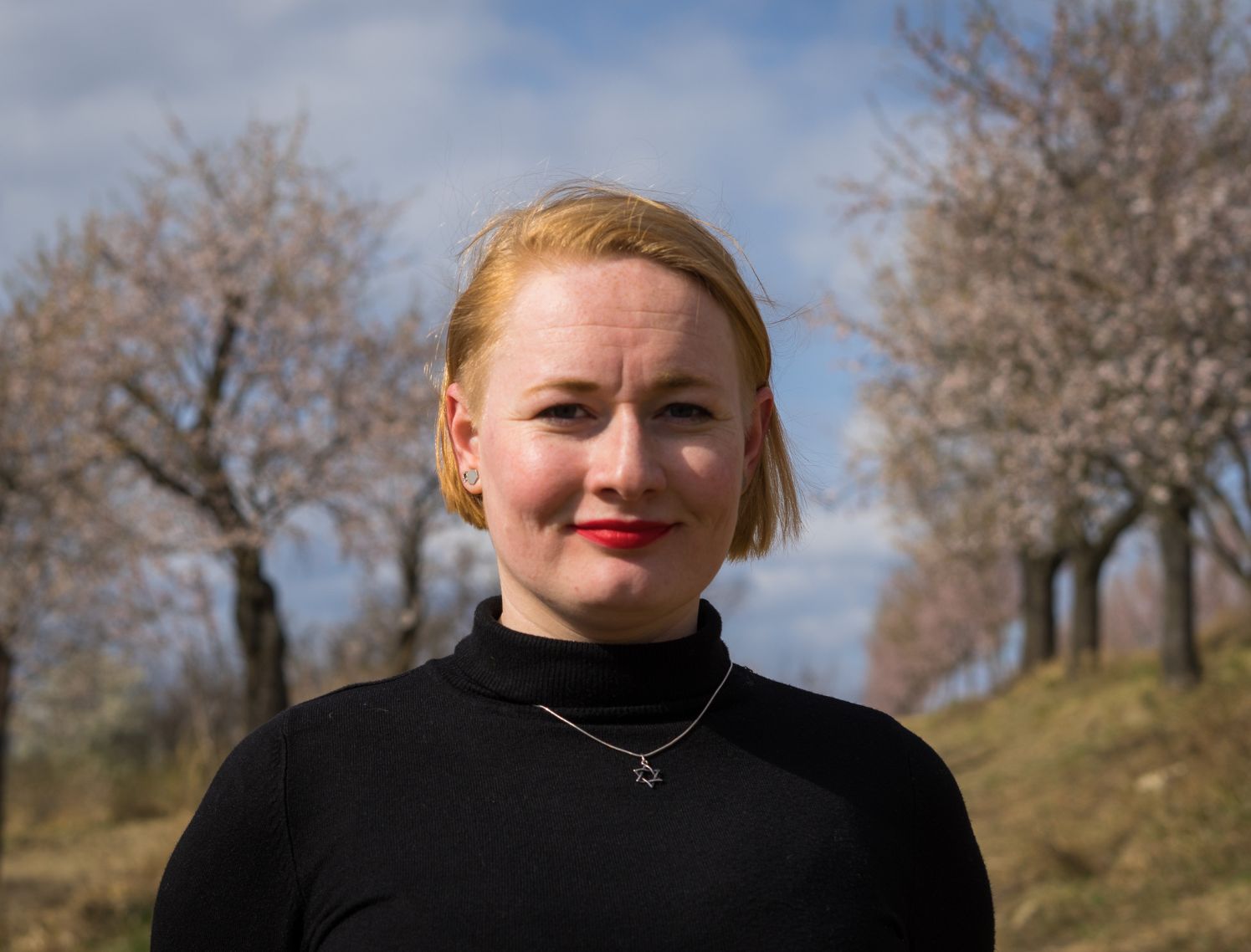
You recently returned from a residency in Wiepersdorf. What was it like? How did you spend those two weeks, and what were you working on?
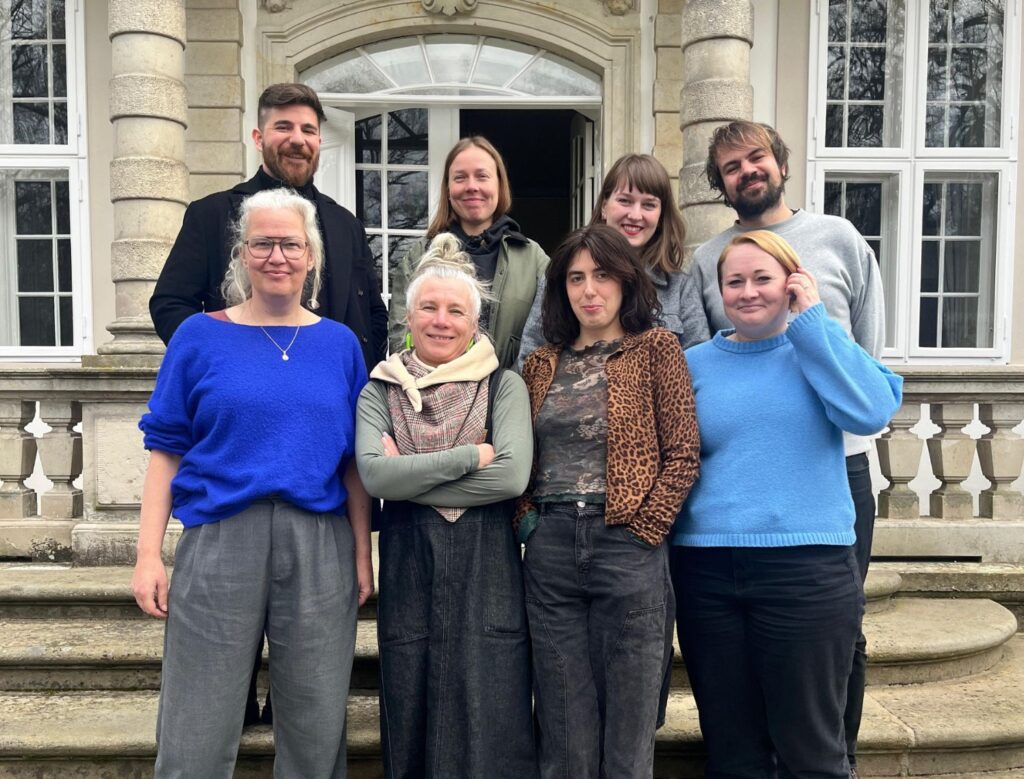
The residency was wonderful. There were eight of us staying at the castle that once belonged to the writer Bettina von Arnim and her husband. Today, the castle serves as a residency space surrounded by windmills, with no mobile phone reception. Four author–illustrator pairs attended, and it was fantastic. On the one hand, it was enriching to spend time with so many talented people at once—such as Markéta Pilátová, Lukáš Csicsely, and Anna Kulíčková. On the other hand, it was invaluable to have the opportunity to work intensively with illustrator Veronika Bílková, with whom I am preparing a book about whale communication and culture. In everyday life, there is rarely enough space for this kind of focused work, so it was wonderful to experience a period in which writing was truly my only job, concern, and joy. Meals were prepared for us at the castle, and we did not have to worry about anything except creating. I am aware of how valuable this is and also what a privilege it represents. I am deeply grateful for these opportunities—they are far from self-evident.
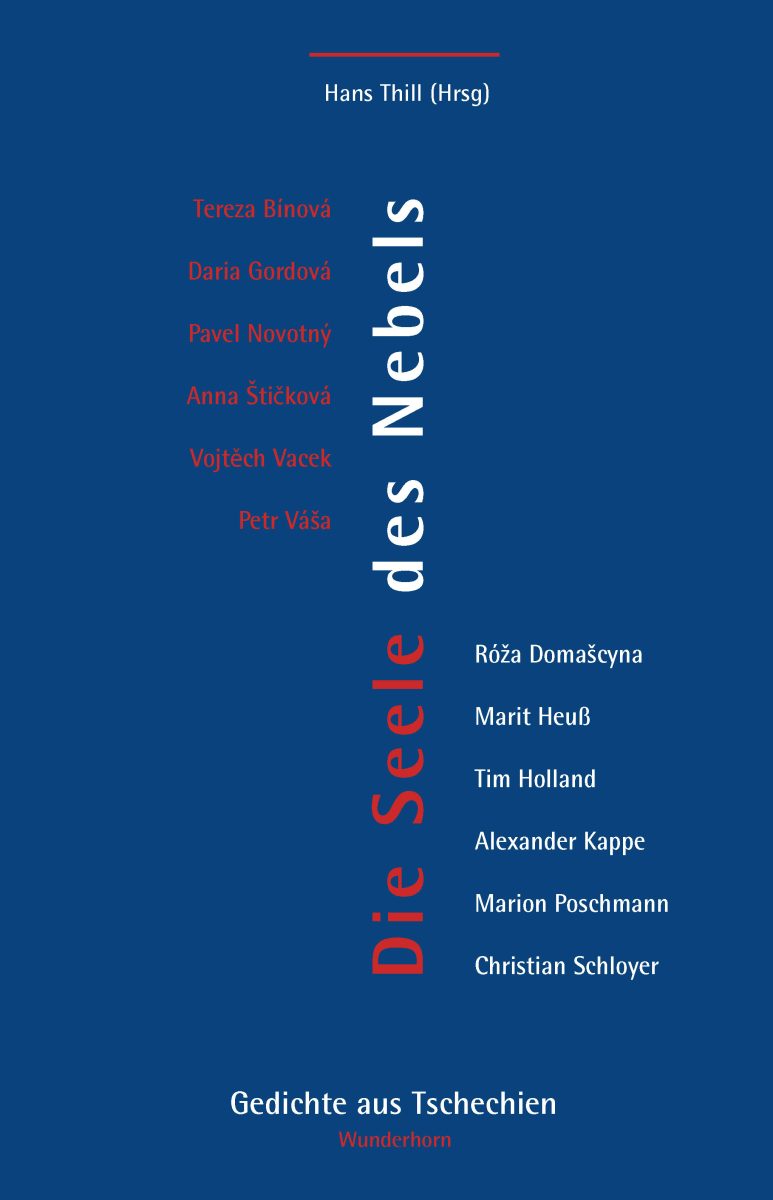
You also presented The Soul of the Mist (published by Das Wunderhorn) at the Leipzig Book Fair, contributing several poems. Could you tell us the story behind this book? How did it come about?
The anthology emerged from another unique project called Poetry of Neighbours, which has been taking place since 1987 in Edenkoben, Germany, within sight of the French border. Every year, six German poets translate the work of six poets from a selected country. Last year, the focus was on Czechia for the first time. Together with Tereza Bínová, Daria Gordová, Vojta Vacek, Pavel Novotný, and Petr Váša, I attended a week-long translation workshop where we discussed our texts and their translations with German poets. It was a very intense experience that significantly changed my own writing and thinking about texts. The anthology is essentially the result of that process—it contains our original poems alongside the various translations. We will present the anthology in Czechia together with the German poets on June 20 at the Knižní lázně literary festival in Mariánské Lázně.
What else are you planning for the festival, and how long have you been organizing it? Was it your initiative?
This year, we are once again welcoming outstanding guests. The festival ambassadors are Dora Kaprálová, who recently won two Magnesia Litera awards, and actress Vica Kerekes, who has long been known for her interpretation of poetry, particularly Slovak and Hungarian poetry. We will also host Petr Borkovec, winner of the Literary Critics’ Prize for Prose, and thanks to our cooperation with Magnesia Litera, many of this year’s award winners across different categories. We have prepared a wonderful program for children as well, including workshops and events with Golden Ribbon nominees Markéta Pilátová, Anna Kulíčková, and Veronika Bílková. Within the German-language program, we will present both the Edenkoben anthology together with Daria Gordová, Marit Heuß, and editor Hans Thill, as well as the zines created during the residency in Wiepersdorf. We warmly invite everyone to attend—the program is truly packed.
Is this your first translation?
Not my very first, but it is the first one to be published in book form. Some of my work has previously appeared in German and English literary journals, but here we are talking about twelve texts, sometimes translated in several different versions by different poets. I think it is a very special experience, one that I would recommend to everyone.
How did you choose the poems included in the anthology? Does the book have a particular thematic focus? What do your poems address?
I selected the texts from my latest poetry collection, Všude pak viděla husy (Then She Saw Geese Everywhere). We were asked to submit a selection of fifteen to twenty poems. The German poets then chose which pieces they wanted to translate, based on literal draft translations prepared by students of Slavic Studies at Heidelberg University. Poetry is almost everywhere a more or less non-profit endeavor, so everything depends on the personal connections and preferences of the translators themselves.
How difficult is it to establish a poetry collection abroad? I would imagine it is much harder than with prose. Is Czech poetry in demand internationally?
I cannot really speak from personal experience, since my entire collection has not yet been published in German. But generally speaking, it is certainly more difficult. Poetry is almost everywhere a largely unprofitable undertaking, so everything depends on personal relationships and the preferences of individual translators. Together with Sylva Ficová, I also translate English-language poetry. I know how difficult it is to publish such works—translation rights are expensive and the market is very small. That is why I am grateful to everyone who translates Czech poetry. They are cultural ambassadors, and I greatly value their work. Among them are people such as Zofia Baldyga, thanks to whom Czech poetry has a strong presence in Poland, and translators such as Julie Miesenböck and Lena Dorn, who translate into German, as well as many others.
You have published three poetry collections, the latest of which, Všude pak viděla husy, was shortlisted for both the Magnesia Litera Award and the Jiří Orten Prize. Are you currently working on anything new?
The last six months have been quite demanding. I recently defended my doctoral dissertation, which I wrote last summer. At that time, it was the most writing I could manage. As a result, I had not been working much on my own creative projects until the residency in Wiepersdorf, where I finally managed to write a substantial portion of the manuscript for my book about whales. There is still a long way to go before the book is finished, but judging by the illustrations Veronika Bílková has already begun creating, there is much to look forward to. Working in tandem with an illustrator is also new for me. She sees what I write in images, and that directly influences the text itself. It is a fascinating journey, and I intend to enjoy every moment of it.
What does a good writing environment mean to you personally? Can an artist residency replace a “room of one’s own”? Where and under what conditions do you write best?
Absolutely. A residency is precisely that. I can write poetry almost anytime and anywhere; in its initial stages, it does not require that much time. But now I am writing a longer, coherent work for the first time—a book for young readers about the ocean and whales. It is a data-based project. Although I also conduct extensive research and fact-checking for poetry, it is not comparable to a work in which I transform scientific knowledge into a literary narrative. The project requires reading academic studies on marine biology in English and draws on interspecies ethnography and the field of Blue Humanities. After extensive research comes the very demanding process of transforming these insights into a fictionalized narrative in Czech. This requires long stretches of concentrated time that I simply do not have in everyday life. In fact, since returning from the residency, I have not touched the manuscript. But overall, the work brings me great joy, and I truly enjoy doing it.
Cover image: Sylva Ficová
The interview with Anna Štičková was conducted by Karolína Tomečková.