

What is special about the Czech book market?
Until recently, the Czech book market was highly diversified. The largest companies did not hold nearly as much market share as is common elsewhere. There were also a great many very small publishing houses—essentially enthusiasts who published books more out of passion than for profit. However, this has been changing in recent years. What remains true, though, is that the Czech book market is still almost entirely Czech-owned.
What can other countries learn from the Czech book industry?
One area in which we can certainly serve as an example is our long-term effort to achieve the lowest possible value-added tax on books. This campaign ultimately succeeded, resulting in a zero VAT rate on books. Our Czech Booksellers and Publishers Association (under my chairmanship) can also serve as an example of how to pursue goals consistently and over the long term. We are not afraid to engage with politicians across the political spectrum, and we never give up.
How has the market changed within the last 10 years?
Over the past ten years, the market has undergone significant consolidation, much like elsewhere in the world. Large publishing houses have been acquiring independent publishers, and bookstore chains have been taking over independent bookstores. Market forces are not the only factor behind this development. Many of the people who founded their businesses after 1989 no longer have the energy to continue, while their children often lack either the interest or the ability to take over.
What did the breakup of Czechoslovakia and the establishment of the Czech Republic in 1993 mean for the book industry?
The breakup of Czechoslovakia itself had no significant impact. What truly mattered was the transition from the socialist planned economy to a free-market economy.
Before 1989, all publishing houses and bookstores were state-owned, and published books were subject to strict censorship. World literature could only be published to a very limited extent. Print runs were determined not by demand but by central planning. Lenin’s writings, for example, were printed in enormous quantities, while ideologically undesirable books appeared in small numbers despite demand being many times greater. Printing houses were also allocated a fixed amount of paper each year, so producing more books was undesirable because it would have disrupted the plan.
After 1989, printing capacity quickly became insufficient because the end of censorship led to the publication of a huge number of previously banned books. Many people who had worked in state publishing houses entered the publishing business themselves, using their expertise and in some cases stripping assets from their former companies. At the same time, enthusiastic entrepreneurs of the new era established new publishing imprints and independent bookstores.
(How) Does Czechia’s communist past still affect the Czech book market today?
I do not believe that the communist past still affects the market itself. We have a completely free book market. However, communism has undoubtedly left its mark on people’s way of thinking. It is remarkable how long these patterns persist. One manifestation is a general distrust of institutions and systems. This distrust can contribute to the actual dysfunction of those systems, which in turn deepens the distrust even further. It is a vicious circle that affects us all. That said, contemporary Western societies are not entirely free from such tendencies either.
Where do you see a chance to grow? Are there problems?
The challenges we face today are global in nature. One of the key questions is whether we can preserve reading as an important component of the modern lifestyle.
Our association commissioned a review of international studies on the benefits of reading—not only for children. Based on its findings, we launched the “ČTI ZA NÁROĎÁK” campaign, which aims to reach the broader public.
To return to your question: growth will only be possible if we can communicate all the remarkable benefits of reading to society. If we can present buying a book as the best possible investment in one’s health, longevity, and the future success of one’s children.
Why do you think Czechia has such a strong tradition of independent publishing houses?
Literary culture played a crucial role in the Czech National Revival during the eighteenth century. People once again began reading, writing, and publishing in the Czech language.
At the same time, we stood culturally between East and West—closer to the West, yet always maintaining certain inclinations toward the East. As a result, there was strong interest in translated literature from both directions. And someone had to publish it.
Which international markets are most important for Czech literature?
I do not see any particular region as having a dominant importance. Of course, the German market is our neighbor and a very strong one. On the other hand, publication in English has universal significance, since editors around the world are accustomed to reading submitted manuscripts in English.
What is your wish for Czechia as Guest of Honour this year?
Although I am the chairman of the Czech Booksellers and Publishers Association, although I founded a major publishing house and earned my living as a publisher, I have always considered myself first and foremost a writer—and have done so since childhood. Writing is the one activity I could never give up. It is my calling, and I feel the significance of what I create, even when it has not yet been fully recognized.
Therefore, when it comes to Frankfurt, my personal wish as an author takes precedence: I hope that my books, my ideas, and the messages they contain will receive worldwide attention commensurate with their value.
One broader wish is that the Czech Republic should not be of interest to others only as an importer of a significant number of literary rights—that is, translation rights for foreign books. Rather, I hope that the business will increasingly develop in the opposite direction as well, through the export of rights from our country to the rest of the world.
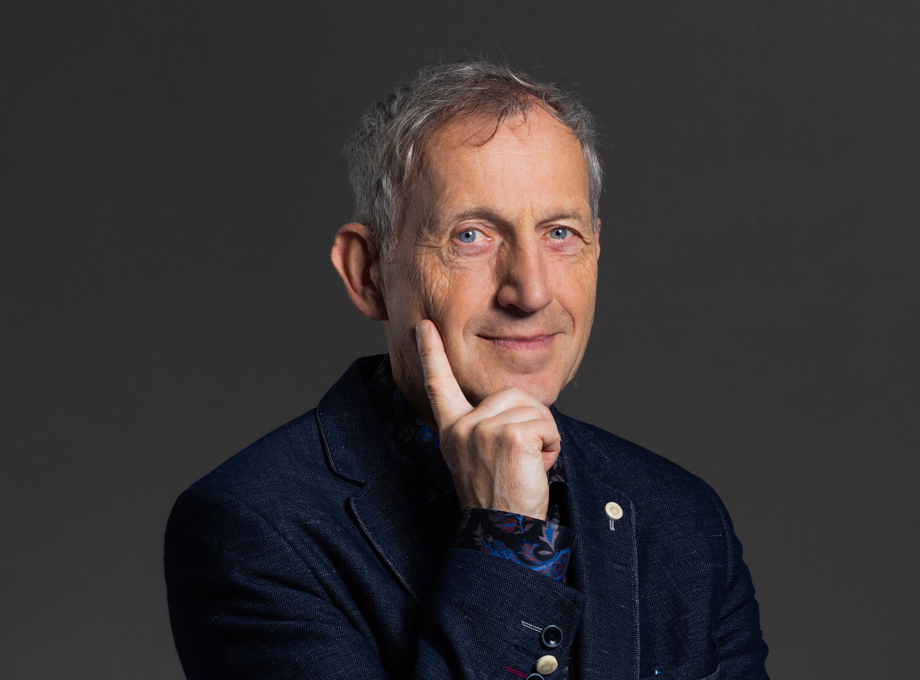
You can find out more about Martin Vopěnka here.
Picture: Connor Jandourek Photostudio
The interview was conducted by Annika Grützner.