

What kinds of things can be expressed in Czech that are difficult or impossible in German?
Diminutives sound very natural—not stilted or contrived. That’s the supple tenderness of the Czech language, which I always strive to convey in German as well.
Does a character’s personality change when you translate them from Czech into German?
Ideally, no. The characters must remain psychologically and sociolinguistically consistent in the translation as well. At its core, the character remains the same, regardless of whether they speak Mandarin or Corsican.
When you translate, do you tend to think in images, in meaning, or in words?
In the magic of language. The attempt to capture it. And I’m convinced that one also translates intuitively. You have to feel the text, immerse yourself in its own logic. Everything should come together in such a way that the German preserves the essence of the original—and transfers its mystery into the new language without ever revealing it.
What is particularly difficult about translating Czech humor into German?
Quite a few people say that Hašek’s “The Good Soldier Švejk” is a survival guide that shows how “the Czech” can successfully muddle through life and come out unscathed. Humor is an integral part of the lifestyle: in the cheeky irony, in muddling through, in resourcefulness. I think almost all Czechs are secret surrealists who are drawn to the bizarre and the grotesque. In Polish, there’s the saying “jak w czeskim filmie”—like in a Czech movie. It refers to a situation that’s chaotic or hard to figure out. I believe that’s exactly where the root of Czech humor lies: in affirming the absurd and even finding pleasure in it. That’s “typically” Czech. And it’s difficult to translate that into a culture where humor is based on completely different premises. (A quick recommendation: Check out the Dadaist fairy tale “Tausendschönchen” by Věra Chytilová! If you find that funny, you’ve grasped Czech humor to some extent.) And honestly: A country where everyone greets each other with “Ahoj” like sailors, even though there’s no sea, must surely have a distinct sense of the absurd…
Which Czech jokes don’t work at all in German?
Jokes that allude to historical events firmly anchored in the cultural memory of the Czech Republic (and Slovakia)—in those cases, you have to come up with other things that are recognizable in a German context and, in the best case, evoke the same humorous associations.
What do you love about Czech that you miss in German?
Speaking from the heart: the magic of words. Conciseness. Evocative power. That ballet-like quality of the vowels (e.g., “krásná báseň”—the words literally float!) or the crunch of the consonants (e.g., “hrst zrn”… it really does grind and crack in your mouth). But beware: German is in no way inferior. It has its own secret weapon—its compound words. How precise, how space-saving! Because in poetry, syllables determine whether a verse works or not.
How has translating changed your own German?
I lie in wait, on the lookout for fresh prey. On the bus, on the tram, on the train. With pencil at the ready and notebook open. There! Someone casually utters something—the phrase, the sentence, the word. The solution I’ve been struggling with for days at my desk. Or I’m poring over some book, my gaze fixed intently on the lines. And suddenly, what I’ve been looking for jumps right out at me. The translator is a predator—he learns to hunt everywhere.
What was the hardest decision you’ve ever had to make in a translation?
There are logical and melodious solutions that are all the more tempting for that very reason. But I have to reject them because they embellish the original. I should be careful not to try to improve on the author. Where a door creaks, it should creak—as far as I’m concerned, it can even crack or groan—but I shouldn’t try to oil the hinges so it opens silently. Anyone who streamlines and smooths out the original too much may produce texts that are correct but sterile. We can confidently trust the reader to make their way through rocky scree, rather than paving the path with a highway to quick understanding.
What are your favorite words in German and Czech?
That reminds me: “smrtonoš a smaltovina,” a line from a poem by Karel J. Čapek (“Čeho se bojíš”), which I translated with similar alliteration as “Todesotter und Mörtelschotter.” Beyond that, at the risk of sounding cheesy, I’ll admit that I like “miláček” (darling) and, in general, the word “něha” (tenderness). There’s something soft and exquisitely delicate about them.
What are you currently working on, and what will your next project be?
In recent months, a collaboration has developed with the avant-garde composer Magdalena Białecka. She writes spectral compositions for a large vocal-instrumental ensemble based on Czech poems—and has also chosen some of my translations for this project. For me, this is a completely new field: the question of how music can correspond with poetry.
Thanks to the Frankfurt Book Fair’s funding programs, I’m now able to bring to light a lot of work that’s been sitting in a drawer for years. There are translations that I’m listening to and rereading to see if they’re ready now or not. I’m currently working on finishing three translations—the poetry collections by Jaromír Typlt, Petr Halmay, and Petr Maděra. The latter two volumes are scheduled to be published in the “Aula-Thule” series by Bohdan Chlíbec’s Aula publishing house; I’ve been captivated by Chlíbec’s poetry for years (especially his collection “Wintergehöft”). In general, I’d love to translate the poets who are said to be “untranslatable.” I always enjoy taking on such challenges. I like this tightrope walk and pushing boundaries. By constantly questioning my own abilities, I can—if I’m lucky—also venture into new forms of language. One such poet was Karel Jan Čapek. A collection of his poems titled “Karel ist krank und liest vor” was recently published by “Ginster Press,” edited by Frank Wierke. Frank is someone who deserves more attention: among other things, he produces portraits of poets and, as an editor, gives a voice to poets who deliberately set themselves apart and forge their own paths.
I’m looking forward to a new collection by Klára Goldstein, but also to collaborating with Klaus Anders, an accomplished translator and poet. He translates from a wide variety of languages and therefore has a wealth of experience. Whenever I get stuck somewhere and am racking my brain, he always puts me back on the right track. His approach to language inspires me—and I’m constantly learning from him.
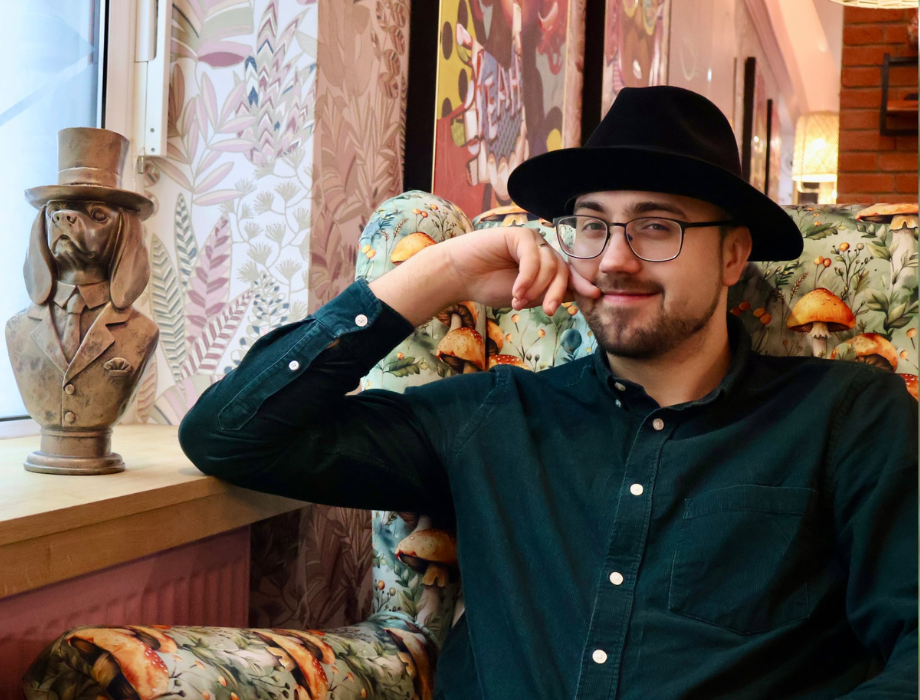
Photo: Dominika Sadowska
The interview was conducted by Nathalie Weber.