

What was your main source of inspiration when designing the pavilion? And how did you work with the motto of the Guest of Honour appearance?
At the outset, we thought the theme of the Czech Republic as a country on the coast was fantastic. We wanted to somehow translate this utopia into the real world. At the same time, we tried to find connections between the coast and books. When we placed these two things side by side and looked for common ground, it struck us that both the coast and books serve as a kind of interface with infinity.
Specifically, with books, these flat volumes in the real physical world, once opened, conceal infinite worlds of imagination within their pages—worlds we can immerse ourselves in at any time. They pull us out of our mundane daily lives and let us drift away to somewhere completely different. We’d love for this essence to shine through in the pavilion’s design as well.
What helped you translate this idea into a physical space?
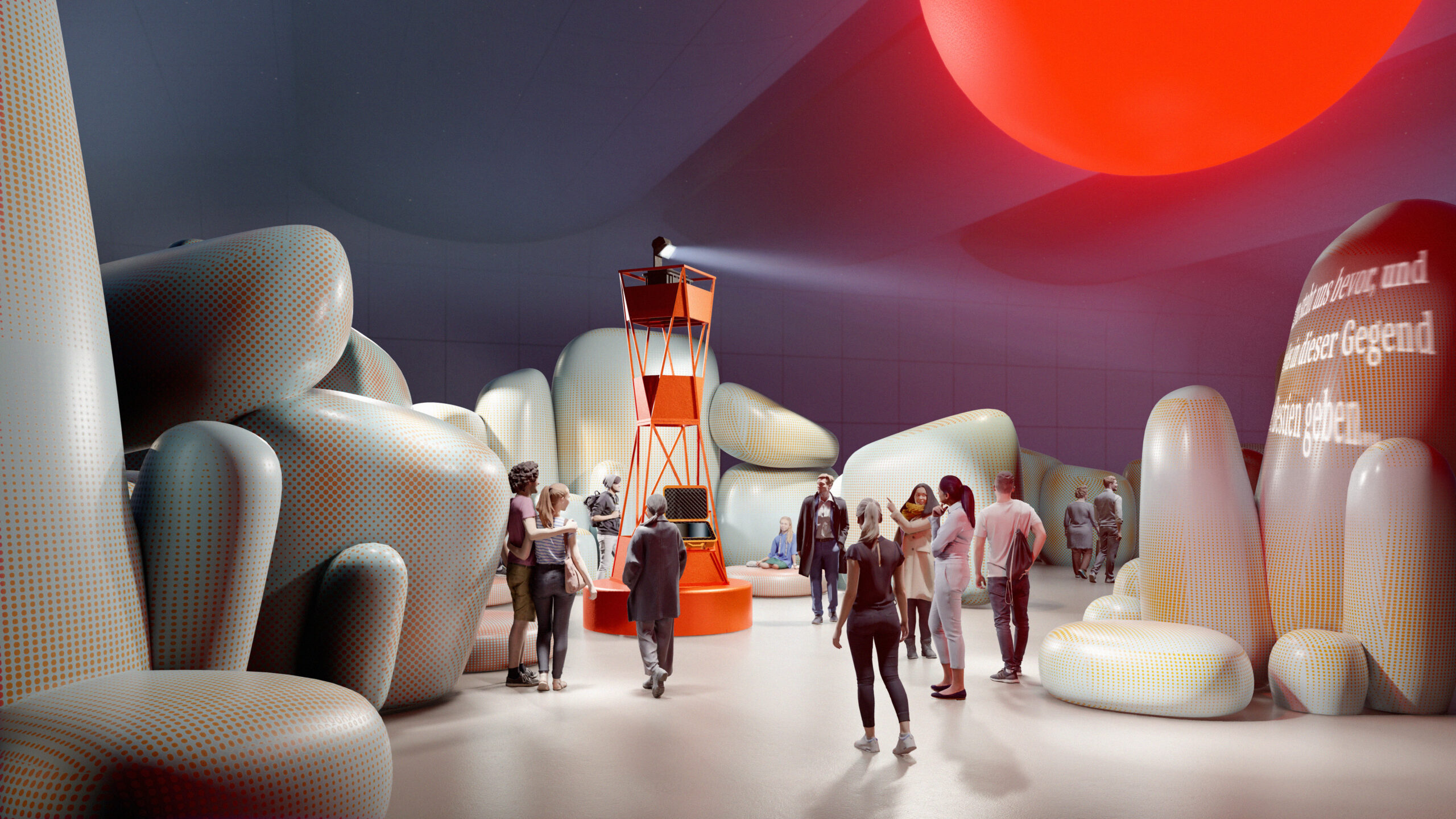
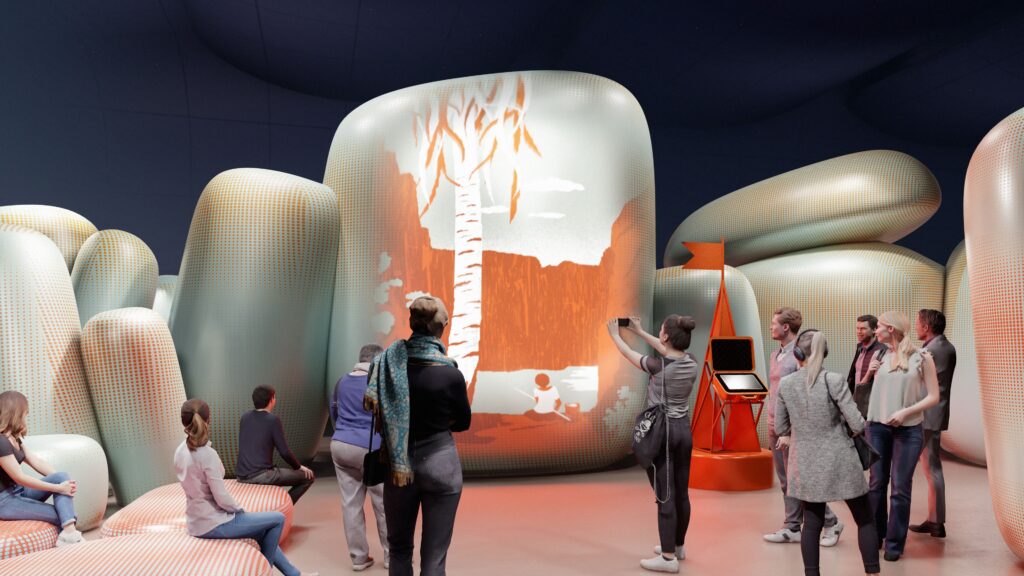
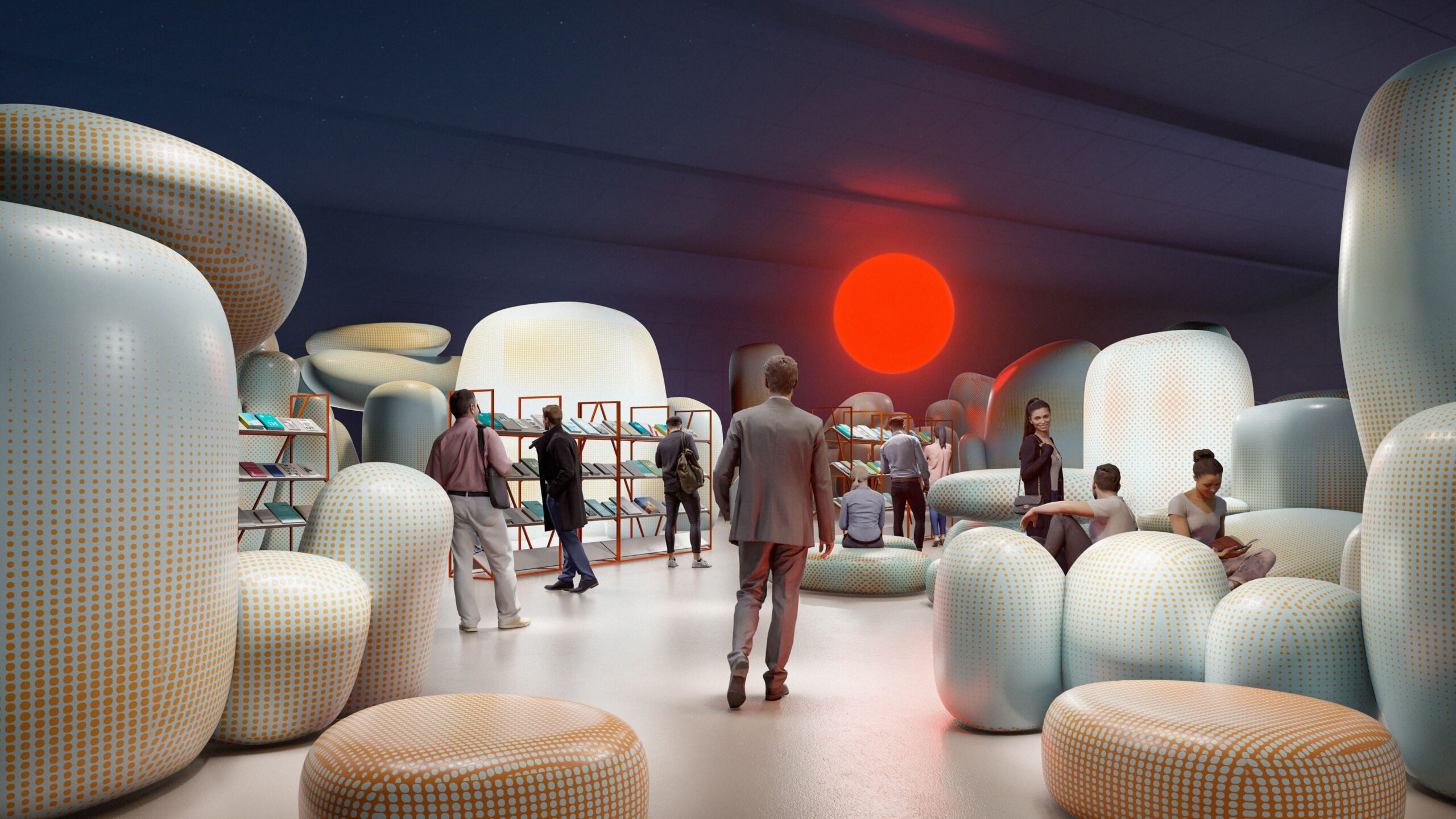
In the pavilion, we use inflatable structures that are as intangible and ephemeral as imagination itself. They aren’t overly explicit. Visitors can imagine virtually anything beneath these structures. The only limits are their imagination and what they take away from the space themselves.
Working with scale was also important to us. These objects are intentionally “scale-less”—they can resemble tiny pebbles washed by water, large rocks, a coastline, or an entire rock city. Visitors can feel like an ant among giant stones, but at the same time like a person walking through a landscape. We strive to ensure that the inflatable structures fill the view as much as possible so that visitors do not notice the pavilion’s walls or know exactly where the space ends. This way, they should get a sense of a boundless landscape and, at least for a moment, forget that they are in the middle of a book fair.
What awaits visitors as they enter this imaginary landscape?
We view the entrance itself as a kind of interface. A person is essentially walking through a book and entering the realm of imagination—into their own mind or into what the book conveys to them. We like the contrast between the relatively standardized environment of a book fair, which has its own clear rules, and the landscape of the pavilion, which operates by entirely different rules.
We wanted visitors to truly be transported mentally and, for a moment, not realize that they were still inside the fairgrounds. They should feel as though they’ve entered another world and aren’t even entirely sure of the scale or setting they currently find themselves in.
What was the biggest challenge for you in working with such a large space?
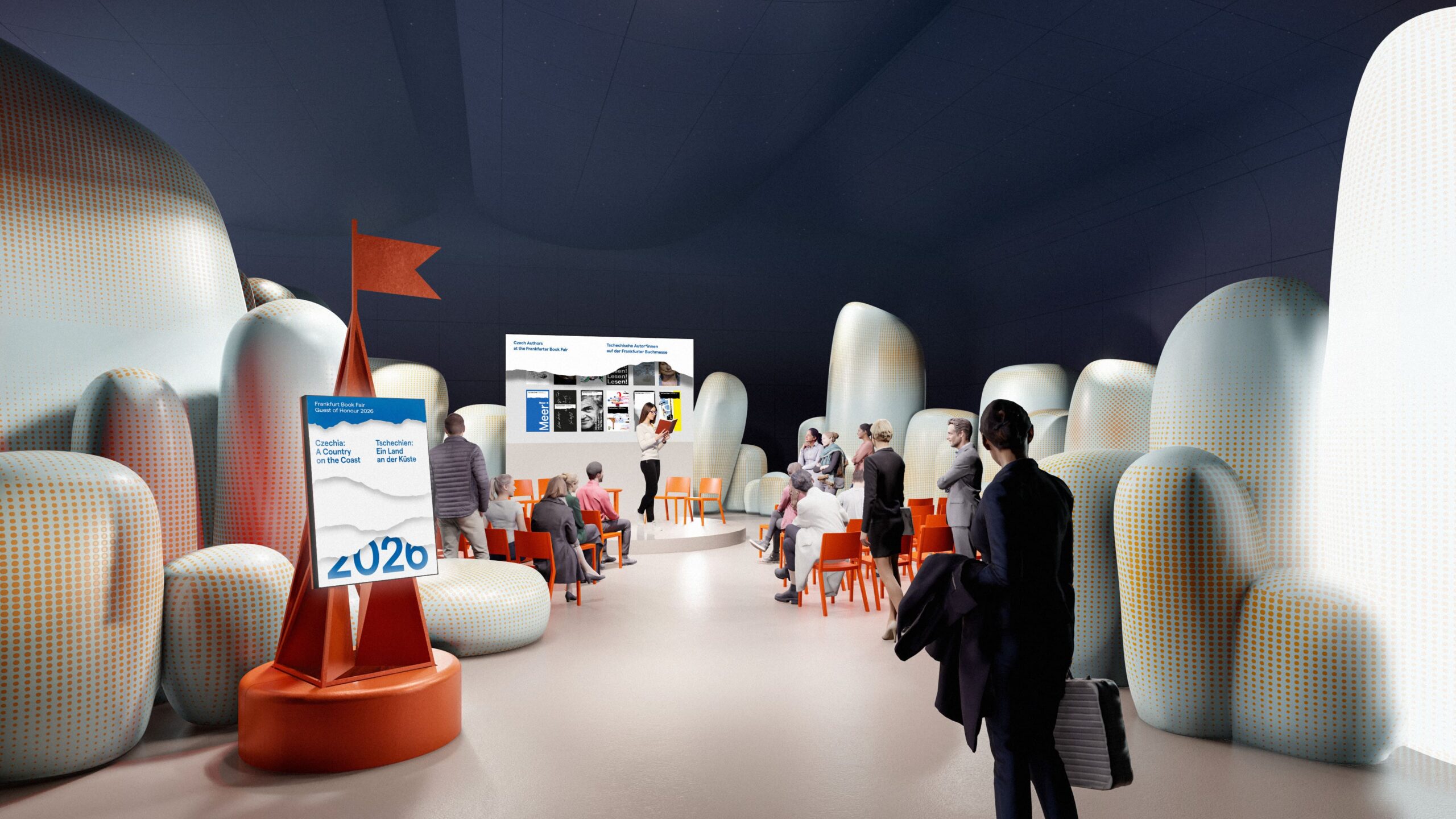
The pavilion will cover approximately 2,500 square meters. It was quite a task for us—to comprehensively address this theme so that the space holds together as a single, cohesive whole. Visitors will find auditoriums, exhibits, a library, and a chill zone there. Bringing all these functions together so that they still form a single whole is a major challenge.
What role does sustainability play in all of this?
It’s very important to us. Inflatable structures not only fill the space well but are also very easy to install and transport. We don’t have to transport large volumes of physical material—on site, we’re essentially working primarily with air, which is everywhere.
This was one of the aspects we took into account. In the exhibition industry, there are often major problems with transporting large volumes of items, from stage equipment to decorations. That was also one of the reasons why we chose inflatable structures. They’re lightweight, easy to install on site, and—importantly—can be reused after the event. So it’s not just a one-off creation designed for a single specific event.
Which specific elements in the pavilion refer to the coastal theme?
From the very beginning, it was important to us not to interpret the theme of the coastal landscape too literally. We didn’t want to simply pour sand into the pavilion and put palm trees there. The inflatable objects may thus remind some people of pebbles on the shore, others of rocks, or perhaps a rock city. That’s what imagination is all about for us—we leave it up to the visitor to decide what they see in them.
Alongside these, there are more specific motifs associated with the sea and the coast, such as a lighthouse or a buoy. These have a certain nautical visual quality, but even with them, we don’t want to impose a single, unambiguous interpretation on visitors. The color scheme is also related to this. The landscape of the inflatable structures itself primarily features shades of beige and blue, while elements inserted into the landscape are highlighted in contrasting orange.
The lighthouse also incorporates light and text. Through it, fragments from the featured books can appear on individual objects, so that the book’s content becomes part of the landscape itself.
What should visitors experience inside the pavilion?
The lighting atmosphere within the pavilion is also important, because we’re striving to ensure that this isn’t just a mere exhibition or presentation of books, but that the space truly makes an impact on visitors. We want it to be a kind of microcosm, a micro-world within the entire book fair, where visitors can come and let their imagination run wild.
The space will be intentionally dimmed, and the lighting will highlight specific points of interest. Working with light and shadow helps us set aside the surrounding fair environment and reinforce the feeling that one has entered another world. A comprehensive scenic design was very important to us, as was its integration with the architectural design, so that both elements form a single whole.
We didn’t want to separate the architecture from the visitors’ scenic experience. You can think of it a bit like a staged theater for visitors as they walk through the space. They have the opportunity to explore the books, but at the same time experience something near the lighthouse or, for example, discover the boundaries of the coastline.
And where does the visitor fit into all of this?
We try to avoid being overly descriptive. We want the design and its form to be metaphorical. Even though we create specifically named places, such as the lighthouse, there should still be room for visitors, who are, in fact, co-creators for us. It is their perception that completes the space.
Some will see stones on the shore in the structures, others a rock city, and still others an entirely different landscape. There is no single, defined experience that a person is supposed to take away from a visit. It’s all about imagination. We’ve also tried to work with emotions, such as curiosity, which could motivate visitors to explore this entire dreamlike landscape much more deeply while also learning about Czech culture along the way.
And as the motto closely associated with Jan Švankmajer reminds us: “All power to the imagination!” So come on over—we look forward to seeing you!
The interview with JinJan was conducted by Jiří Sedlák, Jiří Suchánek, and Karolína Tomečková.